Kamis, 26 September 2019

Missing Seeds: Mysterious Enigma of Supermassive Black Holes - SciTechDaily

Black Holes

In the vast garden of the universe, the heaviest black holes grew from seeds. Nourished by the gas and dust they consumed, or by merging with other dense objects, these seeds grew in size and heft to form the centers of galaxies, such as our own Milky Way. But unlike in the realm of plants, the seeds of giant black holes must have been black holes, too. And no one has ever found these seeds — yet.

One idea is that supermassive black holes — the equivalent of hundreds of thousands to billions of Suns in mass — grew from a population of smaller black holes that has never been seen. This elusive group, the “intermediate-mass black holes,” would weigh in somewhere between 100 and 100,000 Suns. Among the hundreds of black holes found so far, there have been plenty of relatively small ones, but none for sure in the intermediate mass-range “desert.”

Scientists are working with powerful space telescopes from NASA, as well as other observatories, to track down far-flung objects that fit the description of these exotic entities. They have found dozens of possible candidates, and are working toward confirming them as black holes. But even if they do, that opens up a whole new mystery: How did intermediate-mass black holes form?

“What is fascinating, and why people have spent so much time trying to find these intermediate-mass black holes, is because it sheds light on processes that happened in the early universe— what were the masses of relic black holes, or new formation mechanisms for black holes that we haven’t thought of yet,” said Fiona Harrison, professor of physics at Caltech in Pasadena, California, and principal investigator for NASA’s NuSTAR mission.

Black Hole 101

A black hole is an extremely dense object in space from which no light can escape. When material falls into a black hole, it has no way out. And the more a black hole eats, the more it grows in both mass and size.
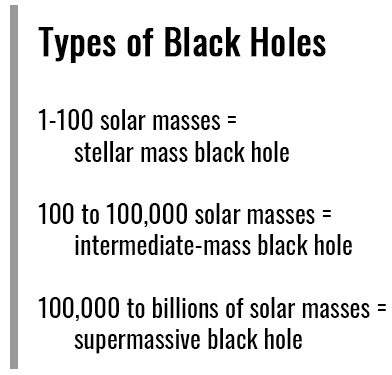
Types of Black Holes

The smallest black holes are called “stellar mass,” with between 1 and 100 times the mass of the Sun. They form when stars explode in violent processes called supernovae.

Supermassive black holes, on the other hand, are the central anchors of large galaxies – for example, our Sun and all other stars in the Milky Way orbit a black hole called Sagittarius A* that weighs about 4.1 million solar masses. An even heavier black hole — at a whopping 6.5 billion solar masses — serves as the centerpiece for the galaxy Messier 87 (M87). M87’s supermassive black hole appears in the famous image from the Event Horizon Telescope, showing a black hole and its “shadow” for the very first time. This shadow is caused by the event horizon, the black hole’s point of no return, bending and capturing light with its strong gravity.

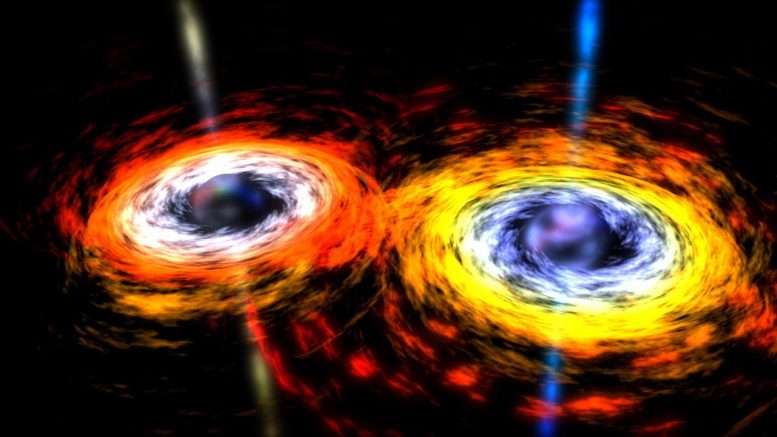
Supermassive black holes tend to have disks of material around them called “accretion disks,” made of extremely hot, high-energy particles that shine bright as they get closer to the event horizon— the black hole’s region of no return. Those that make their disks shine brightly because they eat a lot are called “active galactic nuclei.”

The density of matter needed to create a black hole is mind-boggling.  To make a black hole 50 times the mass of the Sun, you would have to pack the equivalent of 50 Suns into a ball less than 200 miles (300 kilometers) across. But in the case of M87’s centerpiece, it is as though 6.5 billion Suns were compressed into a ball wider than the orbit of Pluto. In both cases, the density is so high that the original material must collapse into a singularity— a rip in the fabric of space-time.
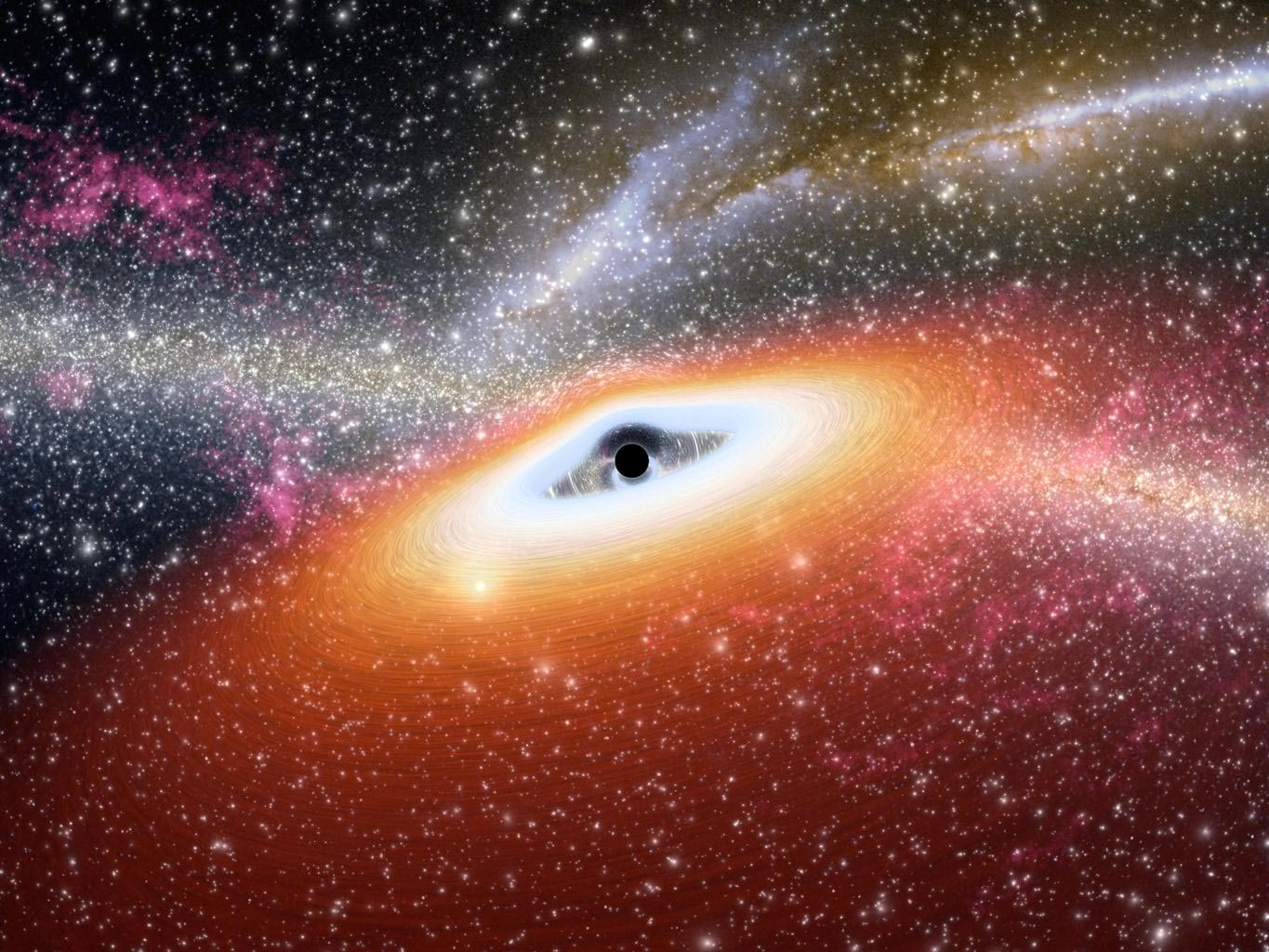
Primitive Supermassive Black Hole

This artist’s conception illustrates one of the most primitive supermassive black holes known (central black dot) at the core of a young, star-rich galaxy. Credit: NASA/JPL-Caltech

Key to the mystery of black holes’ origins is the physical limit on how fast they can grow. Even the giant monsters at the centers of galaxies have limitations on their feeding frenzies, because a certain amount of material is pushed back by the high-energy radiation coming from hot particles accelerated near the event horizon. Just by eating surrounding material, a low-mass black hole might only be able to double its mass in 30 million years, for example.

“If you start from a mass of 50 solar masses, you simply cannot grow it to 1 billion solar masses over 1 billion years,” said Igor Chilingarian, an astrophysicist at the Smithsonian Astrophysical Observatory, Cambridge, Massachusetts, and Moscow State University. But, “as we know, there are supermassive black holes that exist less than 1 billion years after the formation of the universe.”

How to make a black hole you can’t see

Early in the universe’s history, the seed of an intermediate-mass black hole could have formed either from the collapse of a large, dense gas cloud or from a supernova explosion. The very first stars that exploded in our universe had pure hydrogen and helium in their outer layers with heavier elements concentrated in the core. This is a recipe for a much more massive black hole than exploding modern stars, which are “polluted” with heavy elements in their outer layers and therefore lose more mass through their stellar winds.

“If we’re forming black holes with 100 solar masses early in the universe, some of them should merge together, but you basically then should produce a whole range of masses, and then some of them should still be around,” said Tod Strohmayer, astrophysicist at NASA’s Goddard Space Flight Center, Greenbelt, Maryland. “So then, where are they, if they did form?”
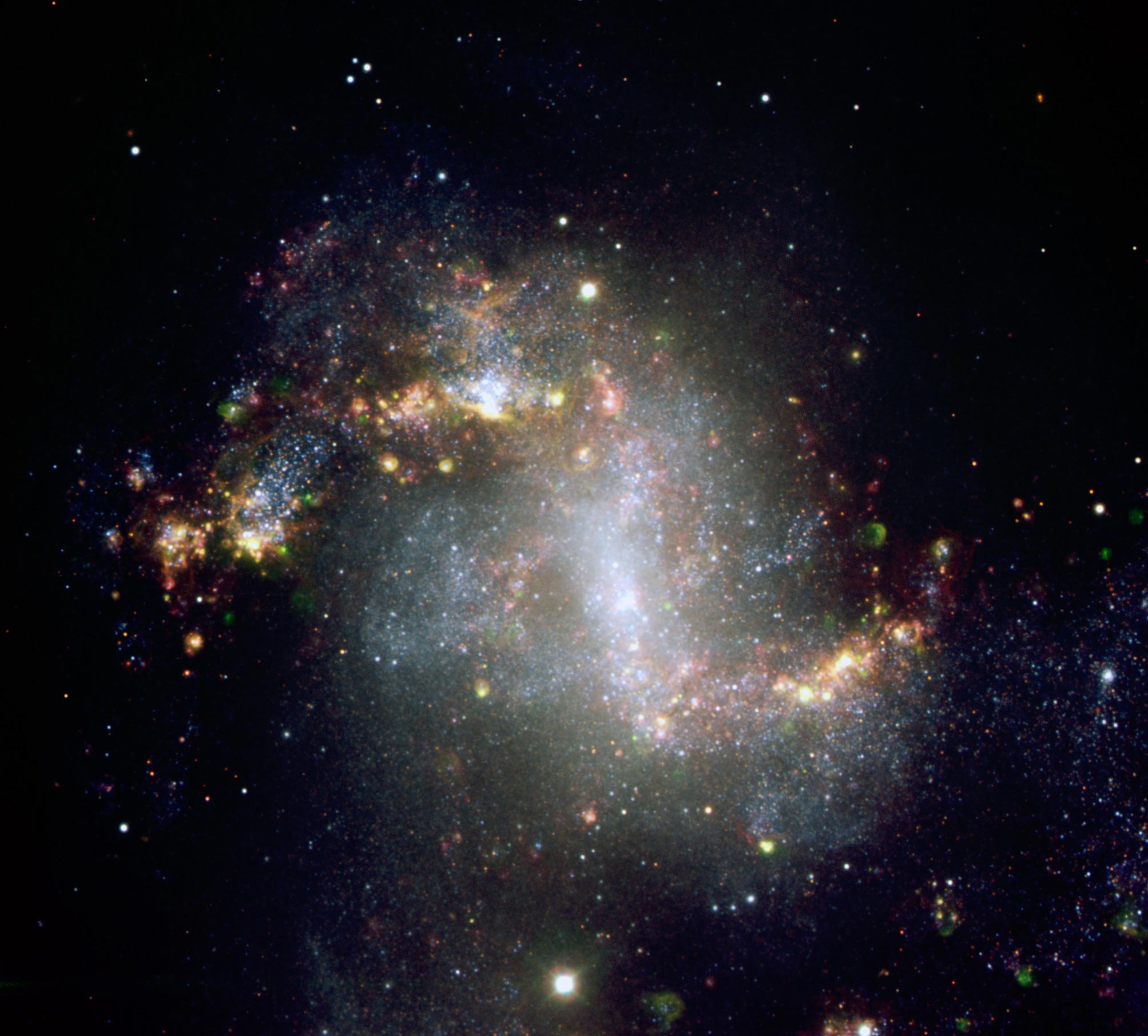
Galaxy NGC1313

A galaxy called ESO 243-49, is home to an extremely bright object called HLX-1. Circled in this image, HLX-1 is the most likely example of a black hole in the intermediate mass range that scientists have found. Credit: NASA; ESA; and S. Farrell, Sydney Institute for Astronomy, University of Sydney

One clue that intermediate-mass black holes could still be out there came from the National Science Foundation’s Laser Interferometer Gravitational-Wave Observatory, LIGO, a collaboration between Caltech and the Massachusetts Institute of Technology. LIGO detectors, combined with a European facility in Italy named Virgo, are turning up many different mergers of black holes through ripples in space-time called gravitational waves.

In 2016, LIGO announced one of the most important scientific discoveries of the last half-century: the first gravitational wave detection. Specifically, the detectors based in Livingston, Louisiana, and Hanford, Washington, picked up the signal of two black holes merging. The masses of these black holes: 29 and 36 times the mass of the Sun, respectively, surprised scientists. While these are still not technically intermediate-mass, they are large enough to raise eyebrows.

It’s possible that all of the intermediate-mass black holes have already merged, but also that technology hasn’t been fine tuned to locate them.

So where are they?

Looking for black holes in the intermediate-mass desert is tricky because black holes themselves emit no light. However, scientists can look for specific telltale signs using sophisticated telescopes and other instruments. For example, because the flow of matter onto a black hole is not constant, the clumpiness of consumed material causes certain variations in light output in the environment. Such changes can be seen more quickly in smaller black holes than larger ones.

“On a timescale of hours, you can do the observational campaign that for classical active galactic nuclei takes months,” Chilingarian said.

The most promising intermediate-mass black hole candidate is called HLX-1, with a mass of about 20,000 times the Sun’s. HLX-1 stands for “Hyper-Luminous X-ray source 1,” and its energy output is a lot higher than Sun-like stars. It was discovered in 2009 by Australian astronomer Sean Farrell, using the European Space Agency’s XMM-Newton X-ray space telescope. A 2012 study using NASA’s Hubble and Swift space telescopes found suggestions of a cluster of young blue stars orbiting this object. It may have once been the center of a dwarf galaxy that was swallowed by the larger galaxy ESO 243-49. Many scientists consider HLX-1 a proven intermediate-mass black hole, Harrison said.
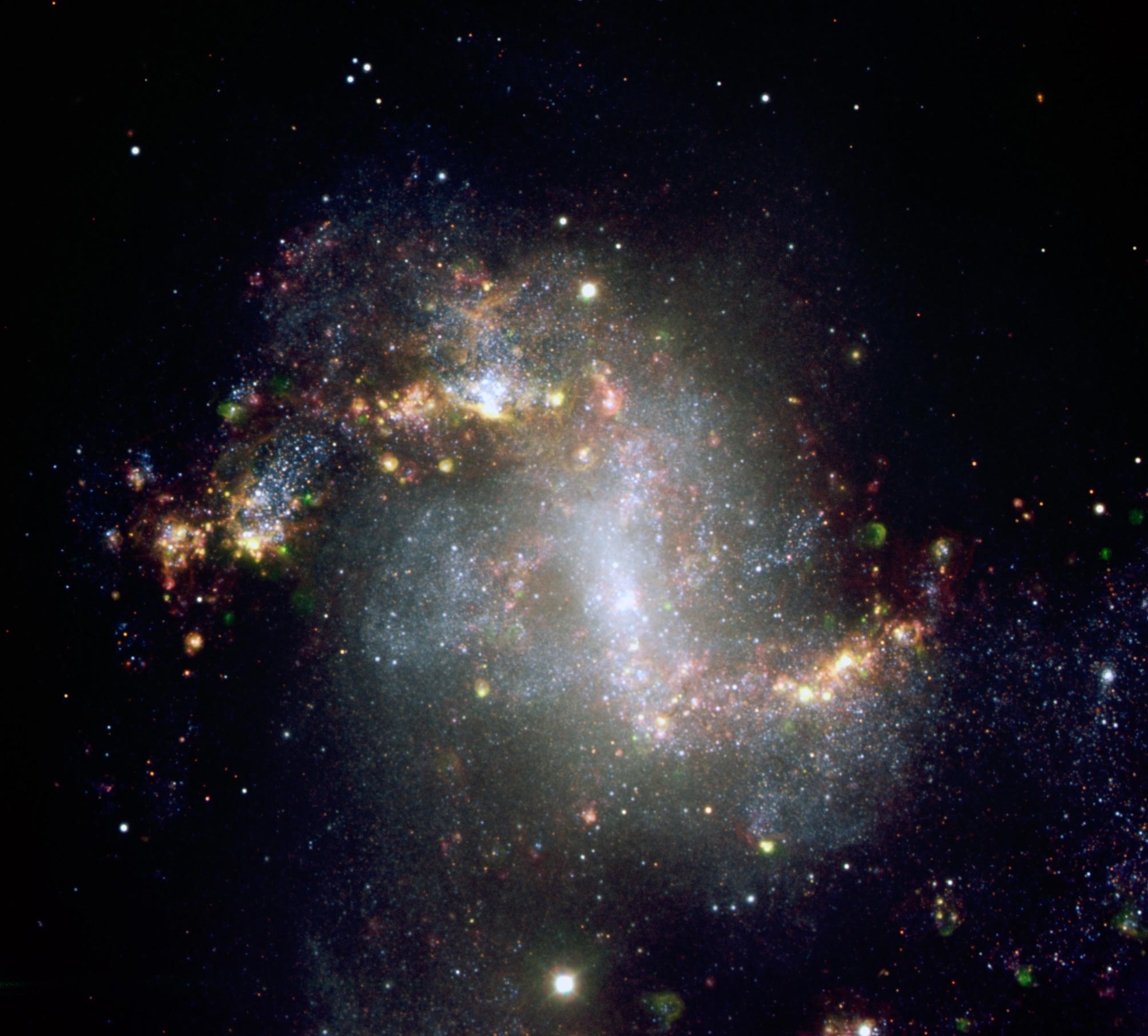
Galaxy NGC1313

This image, taken with the European Southern Observatory’s Very Large Telescope, shows the central region of galaxy NGC1313. This galaxy is home to the ultraluminous X-ray source NCG1313X-1, which astronomers have now determined to be an intermediate-mass black hole candidate. NGC1313 is 50,000 light-years across and lies about 14 million light-years from the Milky Way in the southern constellation Reticulum. Credit: ESO

“The colors of X-ray light it emits, and just the way it behaves, is very similar to a black hole,” Harrison said. “A lot of people, including my group, have programs to find things that look like HLX-1, but so far none are consistent. But the hunt goes on.”

Less-bright objects that could be intermediate-mass black holes are called ultraluminous X-ray sources, or ULXs. A flickering ULX called NGC 5408 X-1 has been especially intriguing to scientists looking for intermediate-mass black holes. But NASA’s NuSTAR and Chandra X-ray observatories astonished scientists by revealing that many ULX objects are not black holes— instead, they are pulsars, extremely dense stellar remnants that appear to pulse like lighthouses.

M82 X-1, the brightest X-ray source in the galaxy M82, is another very bright object that seems to flicker on timescales consistent with an intermediate-mass black hole. These changes in brightness are related to the mass of the black hole, and are caused by orbiting material near the inner region of the accretion disk. A 2014 study looked at specific variations in X-ray light and estimated that M82 X-1 has a mass of about 400 Suns. Scientists used archival data from NASA’s Rossi X-ray Timing Explorer (RXTE) satellite to study these X-ray brightness variations.

Most recently, scientists investigated a bigger group of possible intermediate-mass black holes. In 2018, Chilingarian and colleagues described a sample of 10 candidates by re-analyzing optical data from the Sloan Digital Sky Survey and matching the initial prospects with X-ray data from Chandra and XMM-Newton. They are now following up with ground-based telescopes in Chile and Arizona. Mar Mezcua of Spain’s Institute for Space Sciences led a separate 2018 study, also using Chandra data, finding 40 growing black holes in dwarf galaxies that could be in that special intermediate mass range. But Mezcua and collaborators argue these black holes formed originally in the collapse of giant clouds, rather than by originating in stellar explosions.

What’s next

Dwarf galaxies are interesting places to continue looking because, in theory, smaller star systems could host black holes of much lower mass than those found in the centers of larger galaxies like our own.

Scientists are also searching globular clusters — spherical concentrations of stars located in the outskirts of the Milky Way and other galaxies — for the same reason.

“It could be there are black holes like that, in galaxies like that, but if they’re not accreting a lot of matter, it might be hard to see them,” Strohmayer said.

Intermediate-mass black hole hunters eagerly await the launch of NASA’s James Webb Space Telescope, which will peer back to the dawn of the first galaxies. Webb will help astronomers figure out which came first — the galaxy or its central black hole — and how that black hole might have been put together. In combination with X-ray observations, Webb’s infrared data will be important for identifying some of the most ancient black hole candidates.

Another new tool launched in July by the Russian space agency Roscosmos is called Spectrum X-Gamma, a spacecraft that will scan the sky in X-rays, and carries an instrument with mirrors developed and built with NASA Marshall Space Flight Center, Huntsville, Alabama. Gravitational-wave information flowing from the LIGO-Virgo collaboration will also aid in the search, as will the European Space Agency’s planned Laser Interferometer Space Antenna (LISA) mission.

This fleet of new instruments and technologies, in addition to current ones, will help astronomers as they continue to scour the cosmic garden for seeds of black holes, and galaxies like our own.

Let's block ads! (Why?)


https://scitechdaily.com/missing-seeds-mysterious-enigma-of-supermassive-black-holes/

2019-09-26 04:43:28Z
52780393647940

Rabu, 25 September 2019

The U.A.E.’s First Astronaut Is Going to the Space Station - The New York Times

The United Arab Emirates is about to send its first astronaut to space. That is a step in a budding, ambitious space program for an oil-rich country the size of Maine along the southern side of Persian Gulf. Next year, it plans to send a robotic spacecraft to Mars, and its leaders talk of colonizing the red planet a century from now.

Emirati officials hope that space will inspire and train a generation of engineers and scientists who can help prepare the country for a post-oil future.

Liftoff is 9:57 a.m. Eastern time. NASA Television will broadcast coverage of the launch beginning at 9 a.m. Three astronauts will travel from a spaceport in Kazakhstan in a Russian Soyuz capsule, the only spacecraft on Earth currently capable of trips to the International Space Station. The Soyuz will make a quick six-hour trip to the space station, and NASA will also cover its scheduled 3:45 p.m. arrival.

Early on Wednesday, the Russian space agency confirmed the schedule, and the astronauts were shown heading to the launch site.

Hazzaa al-Mansoori is a former Emirati F-16 pilot. Also aboard will be Jessica Meir of NASA and Oleg Skripochka of Russia.

“I will try to remember each second of the launch itself,” Mr. al-Mansoori said during a news conference this month. “Because it will be really very important for me to share it with everyone and my country, the entire world and the Arab region.”

The station will be crowded for the next eight days with nine occupants before three of them, including Mr. al-Mansoori, head back to Earth on Oct. 3.

During his time in orbit, Mr. al-Mansoori is to help conduct a series of experiments and conduct a tour of the space station in Arabic.

But his trip will also highlight new opportunities for countries looking to enter the space race. The Emirates is not part of the consortium of countries that participate in the International Space Station. Two years ago, the nation did not have any astronauts, either.

In December 2017, Sheikh Mohammed bin Rashid al-Maktoum, the ruler of Dubai, which is one of the seven sheikhdoms that make up the U.A.E., posted on Twitter the nation’s plans to start a human spaceflight program.

Without rockets or a spacecraft of its own, the Mohammed bin Rashid Space Centre in Dubai purchased a seat on the Soyuz from the Russian space agency in the same way that wealthy space tourists have also bought trips to the space station. That is why NASA refers to Mr. al-Mansoori as a “spaceflight participant” and not as a professional astronaut.

The price has not been publicly revealed.

From more than 4,000 applicants who wanted to fill the Soyuz seat, the space center selected two: Mr. al-Mansoori and his backup, Sultan al-Neyadi.

Mr. al-Mansoori, 35, is a father of four.

The two headed to Russia for training, including outdoor survival skills in case the return Soyuz capsule landed far off course. Mr. al-Mansoori has posted on Twitter about his astronaut experiences, mostly in Arabic, occasionally in English:

Some of the experiments that Mr. al-Mansoori will conduct are already waiting for him on the space station. NanoRacks, a Houston-based company, collaborated with the Mohammed bin Rashid Space Centre on a competition that selected 32 experiments from Emirati students studying the effect of weightlessness on materials like sand, steel, corn oil, cement and egg whites.

Additional Emirati experiments include one studying oil emulsification in a weightless environment, as well as a second to germinate a palm date seed native to the country.

NanoRacks announced last week that it will be opening an office in Abu Dhabi, the largest emirate.

“They are serious about becoming a space-faring nation,” Jeffrey Manber, chief executive of NanoRacks, said. “I also like the fact, to be candid, that they comfortably work with Russia, they comfortably work with China and they comfortably work with the United States and the European Space Agency. I think that is a model for the future.”

Euroconsult, an international consulting firm specializing on space markets, reported that the Emirati spent $383 million on space last year. That is much less than the nearly $41 billion spent by the United States or even the $1.5 billion by India, but is more than what Canada spent.

Virgin Galactic signed a memorandum of understanding with the United Arab Emirates space agency in March that aims to set up a spaceport in the country.

Next year, the Emirates intends to launch its Mars mission, a spacecraft called Hope. The probe, on top of a Japanese rocket, is to carry five instruments that are to study the loss of hydrogen and oxygen gases from the upper parts of the Martian atmosphere.

For Hope, the Emirates is working with three American universities: the University of Colorado, Arizona State University and the University of California, Berkeley.

Sultan bin Salman Al Saud, a member of the royal family of Saudi Arabia, was the first Arab and Muslim to go into space as a member of a NASA space shuttle mission in 1985. He now leads the Saudi Space Agency.

Muhammed Ahmed Faris, a Syrian military pilot, flew to the Russian Mir space station in 1987.

Let's block ads! (Why?)


https://www.nytimes.com/2019/09/25/science/emirati-astronaut-uae-international-space-station.html

2019-09-25 09:01:45Z
52780393373337

Mysterious, second interstellar object confirmed - Fox News

It's official. We have our second confirmed – and named – interstellar visitor.

The International Astronomical Union confirmed that the object formally known as C/2019 Q4 (Borisov) is indeed from another solar system, giving it the proper name of 21/Borisov on Tuesday.

"The orbit is now sufficiently well known, and the object is unambiguously interstellar in origin; it has received its final designation as the second interstellar object, 2I," the IAU wrote in a statement. "In this case, the IAU has decided to follow the tradition of naming cometary objects after their discoverers, so the object has been named  2I/Borisov."

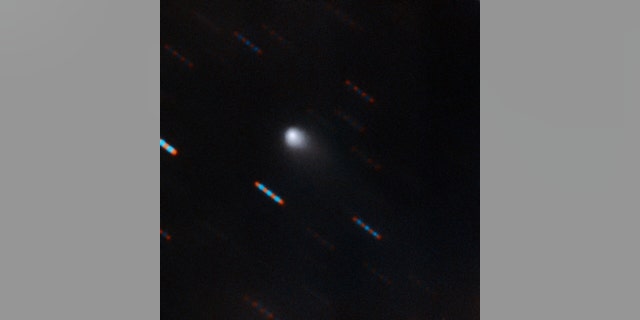
The first-ever comet from beyond our Solar System, as imaged by the Gemini Observatory. The image of the newly discovered object, named 2I/Borisov, was obtained on the night of Sept. 9 using the Gemini Multi-Object Spectrograph on the Gemini North Telescope on Hawaii’s Mauna Kea. (Credit: IAU)

The first-ever comet from beyond our Solar System, as imaged by the Gemini Observatory. The image of the newly discovered object, named 2I/Borisov, was obtained on the night of Sept. 9 using the Gemini Multi-Object Spectrograph on the Gemini North Telescope on Hawaii’s Mauna Kea. (Credit: IAU)

NEWLY DISCOVERED INTERSTELLAR VISITOR COULD BE INTERCEPTED, STUDY SAYS

21/Borisov was discovered on Aug. 30 by astronomer Gennady Borisov and, unlike its predecessor, Ouamuamua, will be observable for an extended period of time. It is likely a comet, given its short tail and "fuzzy" appearance, a description backed up by NASA JPL researcher Davide Farnocchia.

"The comet's current velocity is high, about 93,000 mph [150,000 kph], which is well above the typical velocities of objects orbiting the Sun at that distance," said Farnocchia in a statement posted to NASA's website on Sept. 12. "The high velocity indicates not only that the object likely originated from outside our solar system, but also that it will leave and head back to interstellar space."

Earlier this month, NASA JPL said 21/Borisov is approximately 260 million miles from the Sun and will reach its closest point, known as perihelion, on Dec. 8, 2019, when it gets within 190 million miles of the Sun.

It's still unclear what Oumuamua actually is, although several theories have emerged, including one from Harvard University researcher Avi Loeb that it could be an extraterrestrial lightsail.

COMETS AND ASTEROIDS COULD BE FLINGING LIFE ALL OVER THE GALAXY, STUDY FINDS

The discovery of 21/Borisov raises new questions, IAU noted, including why interstellar objects were not previously discovered, their expected rate of appearance in the inner solar system and how they compare with similar bodies in the solar system.

"Large telescopic surveys capable of scanning large fractions of the sky on a regular basis may help to answer these questions and more in the near future," IAU wrote on its website.

Researchers recently theorized that 21/Borisov could be intercepted using existing technology and studied to determine several aspects about it, such as whether it's a comet or an asteroid. Experts also noted that it could be studied to see, what material, if any, it has picked up from other solar systems.

CLICK HERE TO GET THE FOX NEWS APP

Let's block ads! (Why?)


https://www.foxnews.com/science/second-interstellar-object-confirmed

2019-09-25 12:07:08Z
52780392723241

Selasa, 24 September 2019

Einstein's Theory Predicts a Weird State of Matter. Could It Be Lurking in the World's Largest Atom Smasher? - Livescience.com

[unable to retrieve full-text content]

Einstein's Theory Predicts a Weird State of Matter. Could It Be Lurking in the World's Largest Atom Smasher?  Livescience.com

What happens when particles don't collide, but miss, in the world's largest particle accelerator? New physics!


https://www.livescience.com/lhc-could-find-einstein-missing-matter.html

2019-09-24 11:00:00Z
CBMiR2h0dHBzOi8vd3d3LmxpdmVzY2llbmNlLmNvbS9saGMtY291bGQtZmluZC1laW5zdGVpbi1taXNzaW5nLW1hdHRlci5odG1s0gEA

NASA taps Lockheed Martin to build six more Orion crew capsules - Spaceflight Now

Artist’s illustration of an Orion spacecraft at the moon. Credit: Lockheed Martin

NASA announced Monday it will order at least six reusable Orion crew capsules from Lockheed Martin for $4.6 billion to fly astronauts to the vicinity of the moon in the 2020s, and the agency said it plans to purchase hardware for up to 12 Orion vehicles by 2030.

The Orion Production and Operations Contract, or OPOC, sets up a production line for Orion spacecraft to support NASA’s Artemis program, which aims to return astronauts to the lunar surface in 2024, a deadline set by the Trump administration earlier this year.

“This contract secures Orion production through the next decade, demonstrating NASA’s commitment to establishing a sustainable presence at the Moon to bring back new knowledge and prepare for sending astronauts to Mars,” said NASA Administrator Jim Bridenstine in a statement. “Orion is a highly-capable, state-of-the-art spacecraft, designed specifically for deep space missions with astronauts, and an integral part of NASA’s infrastructure for Artemis missions and future exploration of the solar system.”

The Orion vehicles will ferry astronauts to a mini-space station, or Gateway, in orbit around the moon, where crews will transfer to a different spacecraft to take them to the lunar surface. The lander will bring the astronauts back to the Gateway once their surface missions are complete. Astronauts will leave the Gateway in their Orion spaceship and return to Earth for a splashdown at sea.

After the Artemis program’s first moon landing, NASA plans a series of follow-on missions at a rate of about one per year with expanded exploration capabilities, with the objective of demonstrating technologies and techniques for a future human expedition to Mars.

The Orion spacecraft is a centerpiece of NASA’s lunar exploration program, along with the Space Launch System, a heavy-lift rocket built by Boeing and Northrop Grumman. The SLS will boost the Orion crew capsules toward the moon.

NASA selected Lockheed Martin to develop the Orion spacecraft in 2006, when the capsule was part of the Constellation moon program launched by President George W. Bush. The Constellation program was canceled in 2010, but the Orion spacecraft survived and became part of a new deep space exploration initiative under that Obama administration that focused on a human mission to Mars.

Sometimes called the “multipurpose crew vehicle,” the Orion spacecraft and its SLS launcher have been retargeted toward the moon under the Trump administration.

Before the new agreement announced Monday, NASA had contracted Lockheed Martin to build two Orion spacecraft capable of flying to the moon. The first lunar-capable Orion spacecraft will launch on the Artemis 1 mission, an unpiloted test flight set for launch on the first flight of the Space Launch System heavy-lifter.

The Artemis 1 mission will likely be ready for launch in 2021, followed by the Artemis 2 flight in 2022 or 2023 with four astronauts on-board. Artemis 2 will launch on a trajectory that will take the Orion crew around the moon and back to Earth.

The first of the new batch of Orion crew capsules will launch on the Artemis 3 mission, which NASA has tapped to attempt the first landing on the moon by astronauts since Apollo 17 in 1972.

Mike Hawes, Lockheed Martin’s Orion program manager, said Monday that the company’s new contract with NASA will include crew modules, complete launch abort systems, and adapters to connect the Orion crew modules with their European-made service modules. The contract also covers parts of the European service modules procured by Lockheed Martin, such as auxiliary rocket engines and network interface cards, Hawes said.

The construction of the European services modules themselves is separately funded by the European Space Agency. Airbus Defense and Space is the prime contractor for the Orion service module.

Buying Orion vehicles in groups of three allows Lockheed Martin and its subcontractors to achieve production efficiencies and cost savings, he said.

“The contract is structured as what NASA calls IDIQ, indefinite delivery/indefinite quantity, so they can order as many as they see fit,” Hawes said. “Three is what were able to show NASA was a good break point in terms of being able to get good cost savings by ordering all at once.”

The first set of three Orion vehicles purchased by NASA for $2.7 billion on Monday will come with an average cost of $900 million each. NASA says it plans to order an additional three Orion vehicles in fiscal year 2022 for $1.9 billion, or $633 million per mission.

“I am pleased that Administrator Bridenstine has heeded my calls and is taking significant steps to ensure that Johnson continues to grow with the exciting future of manned exploration that lies ahead,” said Sen. Ted Cruz, R-Texas, in a statement. “More needs to be done, and I look forward to production ramping up in the weeks and months to come and to more opportunities with NASA.”

The NASA announcement of the Orion production contract included statements from Cruz and other Texas lawmakers lauding the role of the Johnson Space Center in Houston, where NASA manages the Orion program. Lockheed Martin’s Orion production line is located at the Operations and Checkout Building at the Kennedy Space Center in Florida.

The Orion spacecraft for the Artemis 1 mission, an unpiloted test flight around the moon expected to launch in 2021, is undergoing final outfitting at the Kennedy Space Center in Florida before shipment to Ohio later this year for environmental testing. Credit: NASA/Radislav Sinyak

“We will heavily reuse all of the components from flight to flight, and we will also reuse full structures, vehicles,” Hawes said. “Some things, like the crew module adapter, since it’s on the service module and gets thrown away each flight, that will be new each flight. The launch abort system, since it gets thrown away each flight, that will be new each flight. But one of the advantages that we have in that second order is we start to see the power of reuse and the price comes significantly down.”

According to NASA, internal computers and electronics, as well as crew seats and switch panels, from the Artemis 2 mission’s Orion spacecraft will be re-flown on Artemis 5. The entire Artemis 3 crew module will be reused on Artemis 6.

“We have doing qualification testing for internal components to five uses,” Hawes told Spaceflight Now in an interview. “Things like the avionics, the flight computers, the communications gear, those kinds of things we anticipate that we will be able to get five uses. The primary structure, for sure two (uses), and we’ll continue to work with NASA to demonstrate the data that we get out of our flight experience. I think we will continue to revise how much we’ll be able to use the structures. But we’re planning for two, at least.”

“That’s the theme,” he said. “Once we demonstrate the capability, then three flights later, that vehicle could fly again.”

The Orion spacecraft can accommodate up to four astronauts for standalone missions lasting up to 21 days. Missions that dock at an in-space destination, such as the Gateway, could last longer.

NASA could order hardware for as many 12 Orion missions from Lockheed Martin under the new production contract, but Hawes said that does not mean the 12 crew modules will be built.

“NASA talks about up to a total of 12 missions,” Hawes said. “That phrase is a little nuanced because with the reuse plan that we’ve the entire time we’ve been planning for this contract, we certainly will not build 12 spacecraft.”

“It’s anticipated that those (6 additional) orders will utilize the full suite of reuse capabilities,” he said. “So those missions NASA will contract with us for, and they may be characterized as light reuse, meaning the components, versus heavy reuse, meaning the structure. We expect when we get the request for proposal for those follow-on missions, that it will actually come with an assumption about what the reuse (plan) for each one of those missions is.”

NASA is ordering the first six Orion vehicles through a “cost-plus-incentive-fee” scheme, a type of contract that treats the Orion spacecraft still as a work in progress. NASA said it will negotiate “firm-fixed-price” orders for follow-on Orion missions, once the spacecraft “design stabilizes and production processes mature.”

“One of the challenges that we have is that we have this first order, we have to make it at this time to meet the Artemis 3 schedule, but we haven’t finished the design of some of the critical systems, like the full life support and the crew controls and displays,” Hawes said. “Those are the biggest pieces that get added. And then in 2022, we anticipate that second … three-mission order … but we will still have not flown Artemis 2, most likely.

“So that’s really the risk factor of those first few flights, is we just haven’t completed and demonstrated the full development task,” Hawes said. “And then from that point on, because of reuse, we see a good (cost) reduction in that second order, and then the follow-on orders will be firm-fixed-price, and we will expect to continue to see price savings.

“We’ve done lots of things in terms of the vehicle to bring price down,” Hawes said. “The bulk ordering is one of the big things that we’ve worked on. We’ve continued to work on advanced technologies, more 3D printing. We actually use augmented reality now in some of our build processes, so a lot of the things that we have been learning over the last couple of years, we’re actually fully putting into place with this new contract.”

Meanwhile, Airbus has delivered the first European service module for the Artemis 1 mission, and production of the second unit for Artemis 2 is well underway. ESA has authorized Airbus to begin procuring hardware for a third Orion service module for the Artemis 3 mission, and European officials have expressed interest in providing additional service modules well into the 2020s.

The service modules provide propulsion, propellants, electricity, water, oxygen, nitrogen and thermal control for the Orion spacecraft.

In a congressional hearing last week, a senior NASA official said the agency aims to have a similar production contract in place for the Space Launch System in about a year.

NASA has spent more than $16 billion on Orion spacecraft development since the program’s start under the George W. Bush administration. When NASA announced Lockheed Martin as the Orion prime contractor in 2006, the first Orion mission with humans on-board was planned in 2014, followed by a crewed lunar landing in 2020.

The development of the Space Launch System started in 2011. At that time, NASA said the first SLS test flight could take off by the end of 2017.

But political redirections, technical problems, poor contractor performance and NASA mismanagement have slowed advancement on the SLS and Orion programs.

In a report released in June, the Government Accountability Office wrote that “contractor performance to date (on the SLS and Orion programs) has not produced desirable program cost and schedule outcomes.” The GAO also identified “significant disconnects” between contractor performance and award fees NASA has paid to Boeing and Lockheed Martin, despite continued delays and cost growth.

The GAO has also “found that NASA has made programmatic decisions — including establishing low cost and schedule reserves, managing to aggressive schedules, and not following best practices for earned value management — that have compounded technical challenges that are expected for inherently complex and difficult large-scale acquisitions.”

“As a result, NASA overpromised what it could deliver from a cost and schedule perspective,” the GAO reported.

Email the author.

Follow Stephen Clark on Twitter: @StephenClark1.

Let's block ads! (Why?)


https://spaceflightnow.com/2019/09/23/nasa-taps-lockheed-martin-to-build-six-more-orion-crew-capsules/

2019-09-24 06:06:42Z
52780391922140

Senin, 23 September 2019

Mysterious Mineral from Earth's Mantle Discovered in South African Diamond - Livescience.com

[unable to retrieve full-text content]

Mysterious Mineral from Earth's Mantle Discovered in South African Diamond  Livescience.com

A single grain of rock lodged in a diamond contains a never-before-found mineral. And that newfound substance could reveal unusual chemical reactions ...


https://www.livescience.com/new-mineral-discovered-in-diamond.html

2019-09-23 11:00:00Z
CBMiQmh0dHBzOi8vd3d3LmxpdmVzY2llbmNlLmNvbS9uZXctbWluZXJhbC1kaXNjb3ZlcmVkLWluLWRpYW1vbmQuaHRtbNIBRmh0dHBzOi8vd3d3LmxpdmVzY2llbmNlLmNvbS9hbXAvbmV3LW1pbmVyYWwtZGlzY292ZXJlZC1pbi1kaWFtb25kLmh0bWw

Colorful New Bee Species Discovered in Fiji, but Extinction From Climate Change Feared - SciTechDaily

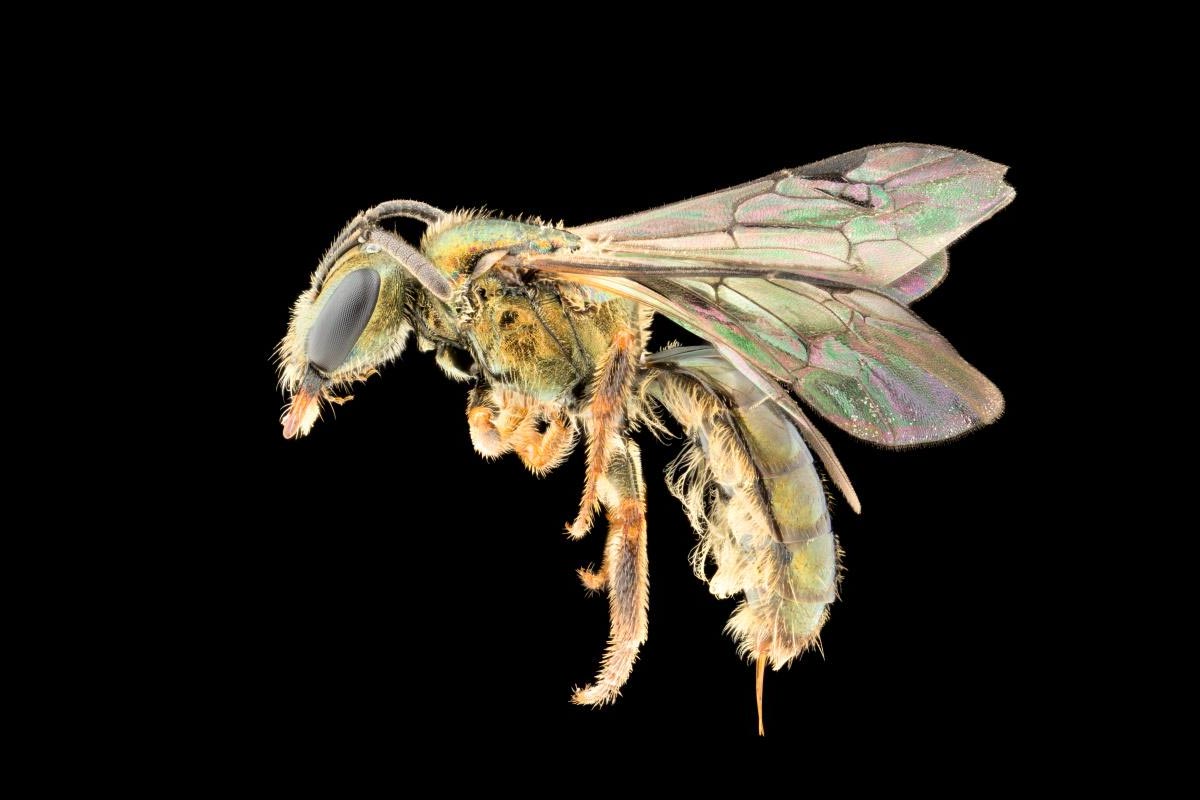
Homalictus terminalis Fijian Bee

Homalictus terminalis is named so to indicate that, like many Fijian bees, it is nearing its limit and is at risk of climate-related extinction. Credit: James Dorey, Flinders University

Bee biodiversity barometer on Fiji — New species described as environment changes

The biodiversity buzz is alive and well in Fiji, but climate change, noxious weeds and multiple human activities are making possible extinction a counter buzzword.

Just as Australian researchers are finding colorful new bee species, some of them are already showing signs of exposure to environmental changes.

Flinders University PhD candidate James Dorey — whose macrophotography has captured some of Fiji’s newest bee species — says the naming of nine new species gives researchers an opportunity to highlight the risks.

“Homalictus terminalis is named so to indicate that, like many Fijian bees, it is nearing its limit and is at risk of climate-related extinction,” he says.

“Found only on Mount Batilamu near the city of Nadi, where many tourists launch their holidays, H. terminalis has only been found within 95 meters of the mountain peak.”

South Australian university students on the Australian Government’s New Colombo overseas study program have gone to Fiji in the south-west Pacific for several years, naming nine new species in one of their latest research publications in Zootaxa.

The impressive black Homalictus achrostus, featuring unusual large mandibles, is one of the most interesting endemic bee species on Fiji.

But, like many Fijian bee species, H. achrostus has only ever found on a single mountain top.

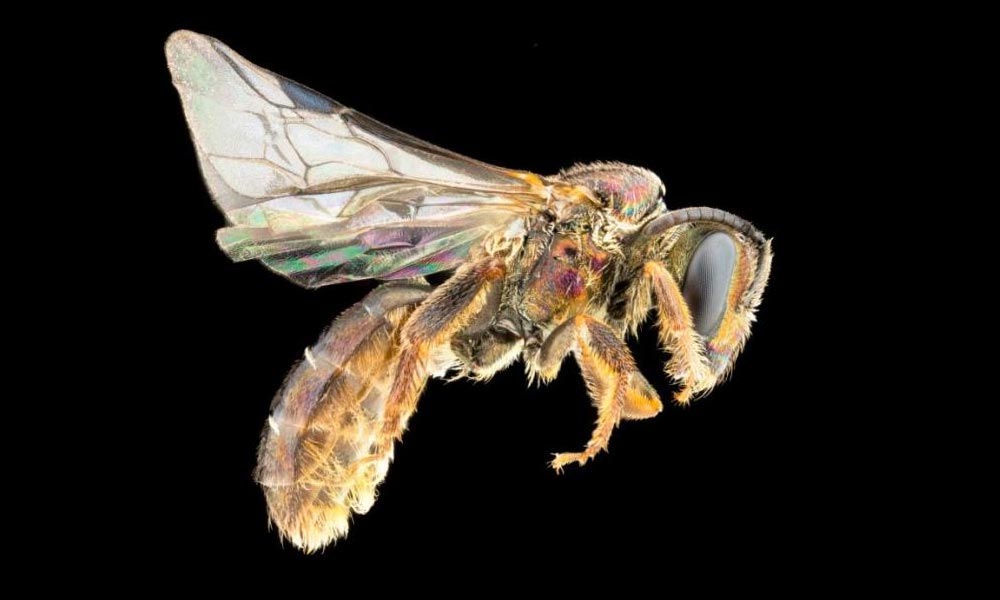
Homalictus groomi New Bee Species Fiji

Australian researchers have combed the highlands of Fiji for new bee species, now describing nine new bee species including Homalictus groomi. Credit: James Dorey, Flinders University nature photographer

“Six individuals were collected on Mount Nadarivatu in the 1970s and two in 2010, but despite frequent searching almost every year since no more have been found,” says Flinders University Associate Professor Mike Schwarz, a co-author on the paper.

“A likely driver of this possible extinction is changing climates,” Associate Professor Schwarz says.

“The cooler climate of the Fijian highlands could be slowly pushed upwards and off the top of the mountains bringing with it the species that require this climatic refuge.

“With H. achrostus one of the four previously described species of endemic bee in Fiji, this raises real concerns about the extinction of many highland species in Fiji and across all of the tropics.”

South Australia Museum senior researcher terrestrial invertebrates, Dr Mark Stevens, says the bee genus Homalictus Cockerell has not been taxonomically reviewed in the Fijian archipelago for 40 years.

“These field trips have allowed us to redescribe four known species and describe nine new ones, bringing the number of endemic Homalictus in Fiji to 13 species,” says Dr Stevens, who is collaborating on the study.

“Most of the species diversity (11 species) live 800 meters or more above sea level, which highlights the vulnerability of highland-restricted species to a warming climate.”

One of the new species, the eye-catching Homalictus groomi, was named in honor of Flinders biological sciences graduate Dr Scott Groom, who began uncovering this hidden diversity using molecular techniques with Flinders University and the South Australian Museum in 2009.

Previous New Colombo Plan biological sciences field trips have also studied the effects of noxious weeds and human activities on other animals and plants in Fiji.

Let's block ads! (Why?)


https://scitechdaily.com/colorful-new-bee-species-discovered-in-fiji-but-extinction-from-climate-change-feared/

2019-09-23 04:51:08Z
CBMib2h0dHBzOi8vc2NpdGVjaGRhaWx5LmNvbS9jb2xvcmZ1bC1uZXctYmVlLXNwZWNpZXMtZGlzY292ZXJlZC1pbi1maWppLWJ1dC1leHRpbmN0aW9uLWZyb20tY2xpbWF0ZS1jaGFuZ2UtZmVhcmVkL9IBc2h0dHBzOi8vc2NpdGVjaGRhaWx5LmNvbS9jb2xvcmZ1bC1uZXctYmVlLXNwZWNpZXMtZGlzY292ZXJlZC1pbi1maWppLWJ1dC1leHRpbmN0aW9uLWZyb20tY2xpbWF0ZS1jaGFuZ2UtZmVhcmVkL2FtcC8