Kamis, 05 September 2019

The Mystery of Bizarre Holes in T. Rex's Head Might Finally Be Solved - ScienceAlert

Despite its popular image of teeth and claws and thunder, Tyrannosaurus rex was no hot-head. New research indicates that the two mysterious holes in the top of the dinosaur's skull likely helped regulate temperatures inside its head.

Previously, these holes - called the dorsotemporal fenestra - were thought to be filled with muscles that helped operate the powerful jaw. But, according to anatomist Casey Holliday of the University of Missouri, something didn't quite add up.

"It's really weird for a muscle to come up from the jaw, make a 90-degree turn, and go along the roof of the skull," he said.

"Yet, we now have a lot of compelling evidence for blood vessels in this area, based on our work with alligators and other reptiles."

Similar fenestra can be found in the skulls of a class of animals known as diapsids, grouped together because of this feature. This class includes not only crocodilians, but also birds, lizards, and tuatara; the holes are thought to have evolved about 300 million years ago.

Fenestra are not found in all dinosaur skulls, but those that do have them include tyrannosaurs and pterosaurs. To start figuring out what these holes were for, the team analysed different diapsid skulls to determine which ones had fenestra most similar to T. rex; the closest similarities turned out to be with crocodilians.

So, Holliday and his co-authors - William Porter and Lawrence Witmer from Ohio University, and Kent Vliet of the University of Florida - took thermal imaging cameras and went to study a bunch of alligators at the St Augustine Alligator Farm Zoological Park.

Because alligators are cold-blooded, or ectothermic, their body temperature is dependent on the temperature of their environment. This means that their thermoregulation processes are very different from warm-blooded, or endothermic, organisms.

"We noticed when it was cooler and the alligators are trying to warm up, our thermal imaging showed big hot spots in these holes in the roof of their skull, indicating a rise in temperature," Vliet said.

"Yet, later in the day when it's warmer, the holes appear dark, like they were turned off to keep cool. This is consistent with prior evidence that alligators have a cross-current circulatory system - or an internal thermostat, so to speak."
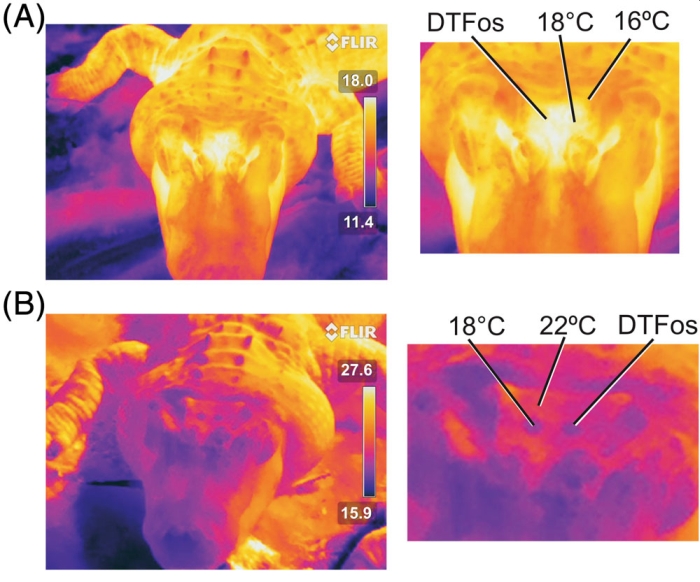
glowcroc(Holliday et al., The Anatomical Record, 2019)

It's not yet known whether dinosaurs in general, and T. rex in particular, were ectothermic or endothermic.

The topic is actually hotly debated, with some scientists thinking the former, some the latter, and some believing dinosaurs fell somewhere between the two - a feature called mesothermy. Previous research has suggested that the armoured ankylosaur had "crazy straw" tunnels in its skull to help keep its brain at optimum temperatures.

Now this research suggests that T. rex (and other dinosaurs) use some of the thermoregulation tactics of ectotherms, but what that actually means within the broader context of their metabolisms is yet to be explored.

What the scientists can tell, based on this research, is that there are no osteological features on the skull of the tyrannosaurus that indicate the fenestra were sites of muscle attachment. They can also infer, based on modern alligators, that the fenestra could have been used to regulate temperature in the T. rex's skull, by warming or cooling the blood that flows through blood vessels in the structures.

"We know that, similarly to the T. rex, alligators have holes on the roof of their skulls, and they are filled with blood vessels," Witmer said.

"Yet, for over 100 years we've been putting muscles into a similar space with dinosaurs. By using some anatomy and physiology of current animals, we can show that we can overturn those early hypotheses about the anatomy of this part of the T. rex's skull."

The team's research has been published in The Anatomical Record.

Let's block ads! (Why?)


https://www.sciencealert.com/tyrannosaurus-rex-had-holes-in-its-head-to-help-keep-its-cool

2019-09-05 04:55:37Z
52780373348754

Selasa, 03 September 2019

Europe's oldest lake traces 1.36 million years of climate - Phys.org

Europe’s oldest lake traces 1.36 million years of climate
Dr Alexander Francke from the School of Earth, Atmospheric and Life Sciences, University of Wollongong, Australia. Credit: Paul Jones, UOW

By analysing sediment cores from the bed of Europe's oldest lake, an international team of scientists has created a detailed climate history of the north-central Mediterranean stretching back 1.36 million years—and revealed the climate mechanism that has driven winter rainfall in the region.

The scientists, including Dr. Alexander Francke from the University of Wollongong (UOW), drilled into the bed of Lake Ohrid, which lies on the border of Albania and North Macedonia and is thought to be the oldest in Europe. The study was led by Associate Professor Bernd Wagner from the University of Cologne and Dr. Hendrik Vogel from the University of Bern.

The results of their research are published in the prestigious scientific journal Nature.

By providing an unprecedented understanding of the factors that have driven the Mediterranean region's climate in the past, the data they collected will help scientists to model more accurately the region's future climate under global warming.

The drilling took place in water 245 metres deep and reached a maximum depth of 568 metres into the sediment. Analysis revealed that Lake Ohrid first established 1.36 million years ago and has existed continuously since then. The extensive sediment succession allowed the researchers to reconstruct climate over the entire history of the lake in exquisite detail.

Geochemical data and the pollen record show that increased in the north-central Mediterranean region during warm, interglacial periods. During these intervals, indicate increased cyclogenesis (the development and strengthening of low-pressure areas in the atmosphere) over the Mediterranean Sea during summer and late autumn leading to considerably higher winter rainfall.

The Mediterranean climate is characterised by dry summers and , so winter rainfall is vital for the region's population and agriculture.

Europe’s oldest lake traces 1.36 million years of climate
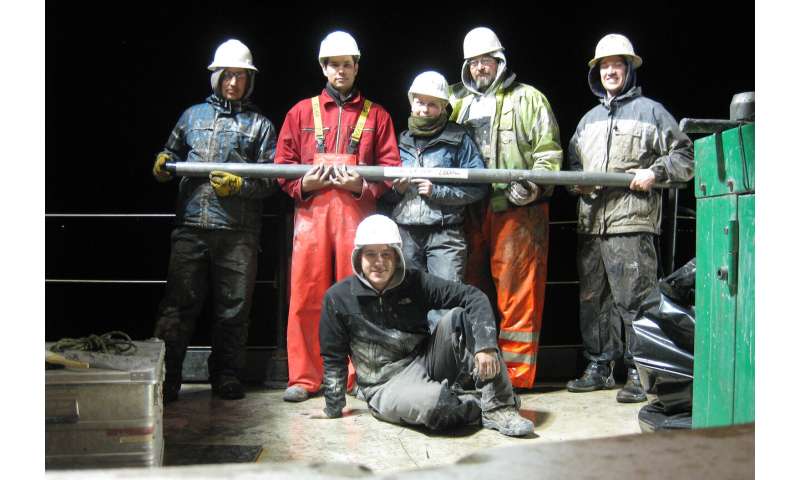
The night-shift team celebrates recovery of 2,000 m of sediments. Dr Alexander Francke is second from left. Credit: Alexander Francke

"We discovered a teleconnection between the African monsoon and winter precipitation in the Mediterranean region, so between tropical climate systems and rainfall in the mid-latitudes thousands of kilometres away," said Dr. Francke, a Research Fellow at the Wollongong Isotope Geochronology Laboratory.

"Whenever incoming solar radiation from the sun is enhanced in the northern hemisphere you have this northward migration of the tropical climate system and we see increased rainfall in winter at Lake Ohrid. We see this mechanism consistently over the past 1.3 million years."

During these warmer periods, the northward move of tropical climate systems caused higher sea surface temperatures in the Mediterranean and increased evaporation, amplifying local cyclone development in the Mediterranean and strengthening of North Atlantic low-pressure systems migrating eastwards.

"This climate system would be fairly stable during the summer and autumn until the temperatures decrease in winter and cold air from the north causes the whole system to become unstable and this low pressure system moves eastwards towards the Balkan Peninsula and promotes rainfall in the winter months," Dr. Franke explained.

There is currently a discrepancy in climate models about how will affect the Mediterranean climate and, in particular, how it will affect winter rainfall: some models show increased winter precipitation, others show it becoming drier.

Dr. Francke says the data gathered from Lake Ohrid will enable a better understanding of how climate change will affect the region. However, because recent human-driven climate change has different causes than previous warmings, it is not yet certain whether it will lead to a similar increase in winter rainfall in the Mediterranean.

"We have to be careful. We can't just take these results and say that if it gets warmer in the future there will also be more rainfall during winter in the Mediterranean," Dr. Francke said.

"Some climate models are predicting more winter rainfall but others are predicting drier winters. However, modellers will now be able to use the data we gathered from Lake Ohrid to improve their models and develop more accurate predictions of what will happen in the future."


Explore further

Experts find the origins of Europe's climate hidden in shrimp shells

More information: Bernd Wagner et al. Mediterranean winter rainfall in phase with African monsoons during the past 1.36 million years, Nature (2019). DOI: 10.1038/s41586-019-1529-0

Citation: Europe's oldest lake traces 1.36 million years of climate (2019, September 3) retrieved 3 September 2019 from https://phys.org/news/2019-09-europe-oldest-lake-million-years.html

This document is subject to copyright. Apart from any fair dealing for the purpose of private study or research, no part may be reproduced without the written permission. The content is provided for information purposes only.

Let's block ads! (Why?)


https://phys.org/news/2019-09-europe-oldest-lake-million-years.html

2019-09-03 07:53:23Z
CAIiEI0fZiOl3mVoE3gTep6NcBIqFwgEKg8IACoHCAowpbDpAzCm_hwwj9kp

India's Chandrayaan-2 ready for moon landing - Aljazeera.com

The landing module of India's unmanned moon mission separated successfully from the orbiter on Monday in the run-up to its planned touchdown on the moon's south polar region this weekend, the country's space agency said.

All the systems of the orbiter and the lander are "healthy," the Indian Space Research Organisation said in a statement.

Monday's manoeuvre removed the lander from the orbiter's top, where it had been sitting since the mission took off from southern India on July 22.

The module has reached a distance of about 100km from the moon's surface, the space agency said.

It will attempt India's first moon landing on a relatively flat surface on Saturday to study previously discovered water deposits.

The roughly $140m mission is known as Chandrayaan-2, the Sanskrit word for "moon craft."

Chandrayaan-1 orbited the moon in 2008 and helped confirm the presence of water.

Space agency Chairman K Sivan has said that landing on the lunar surface involves a lot of technical complexities - an event he described as "15 terrifying minutes."

If India does manage the landing, it will be only the fourth country to do so after the United States, Russia and China.

India plans to send humans into space by 2022.

Let's block ads! (Why?)


https://www.aljazeera.com/news/2019/09/india-chandrayaan-2-ready-moon-landing-190903012517283.html

2019-09-03 01:46:00Z
CBMiYmh0dHBzOi8vd3d3LmFsamF6ZWVyYS5jb20vbmV3cy8yMDE5LzA5L2luZGlhLWNoYW5kcmF5YWFuLTItcmVhZHktbW9vbi1sYW5kaW5nLTE5MDkwMzAxMjUxNzI4My5odG1s0gFmaHR0cHM6Ly93d3cuYWxqYXplZXJhLmNvbS9hbXAvbmV3cy8yMDE5LzA5L2luZGlhLWNoYW5kcmF5YWFuLTItcmVhZHktbW9vbi1sYW5kaW5nLTE5MDkwMzAxMjUxNzI4My5odG1s

Senin, 02 September 2019

India set for moon landing attempt after Chandrayaan-2 spacecraft separation - SpaceNews

Successful separation of the Chandrayaan-2 orbiter and lander clears the way for historic landing attempt Sep. 6.

HELSINKI — India will attempt to become the fourth country to soft land on the Moon Friday after successful separation of the Chandrayaan-2 lander and orbiter early Monday.

The separation event took place at 3:45 a.m. Eastern Monday, just under a day after the Chandrayaan-2 spacecraft carried out a final orbit change to lower its orbit to a 119- by 127-kilometer lunar orbit.

“All the systems of Chandrayaan-2 Orbiter and Lander are healthy,” the Indian Space Research Organisation (ISRO) announced in a statement released shortly after separation.

The Vikram lander is now set to perform two deorbit burns, at 11:30 p.m. Sep. 2 and 5:30 p.m. Sep.3 Eastern, to lower the orbit to a planned 36- by 110-kilometer orbit. These will be followed by powered descent and touchdown between 4 p.m. and 5 p.m. Eastern Sep. 6.

A successful touchdown Friday by the Vikram lander would make India the fourth country to achieve a lunar landing after the U.S., the former Soviet Union and China.

The 1,471-kilogram lander is named for Dr Vikram A Sarabhai, the founder of the Indian Space Research Organisation (ISRO). It also carries a 27-kilogram rover named Pragyan, which translates to ‘wisdom’ in Sanskrit.

Long lunar journey

Chandrayaan-2 has taken a relatively circuitous route to the moon. Launch took place July 22 at the Satish Dhawan Space Centre atop of a GSLV Mk 3 launch vehicle, with five orbit raising maneuvers performed before trans-lunar injection Aug. 13. The spacecraft entered lunar orbit Aug. 20, then carrying out five orbit lowering burns before the final, 52-second burn Sunday.

The Chandrayaan-2 orbiter is designed to operate in a 100 by 100-kilometer lunar polar orbit for one year. Its eight payloads include a Terrain Mapping Camera, which will produce a 3D map for studying lunar mineralogy and geology. It also carries an X-ray spectrometer, solar X-ray monitor, imaging spectrometer and a high-resolution camera.

Vikram will communicate with both the terrestrial Indian Deep Space Network at Byalalu near Bangalore and the orbiter. It will also facilitate communications with the rover, with carries two payloads, a speed of 1 centimeter per second and a range of 500 meters. Both the lander and rover have a mission lifetime of one lunar day, equivalent to about 14 Earth days.

Mission science goals include mapping, investigating surface  composition, detecting hydroxyl and water ice signatures and surveying the tenuous lunar exosphere.

Chandrayaan-2 is ISRO’s second lunar mission, following the Chandrayaan-1 orbiter launched October 2008.

Let's block ads! (Why?)


https://spacenews.com/india-set-for-moon-landing-attempt-after-chandrayaan-2-spacecraft-separation/

2019-09-02 09:22:33Z
52780368057605

Minggu, 01 September 2019

Asteroid danger: '100% chance of impact' space expert alerts in 'life or death' warning - Express.co.uk

An impact 66 million years ago triggered a chain reaction of events that wiped out the dinosaurs and two-thirds of life on Earth. Since the killer asteroid struck Earth, many smaller space rocks and comets have pelted the planet. Thankfully, we are yet to see another large object fly directly towards us – an event which NASA claims happens once “every few million years”. As a result, scientists are certain a space rock will hit Earth sooner or later and preparations need to be made for when it happens.

Lembit Öpik, the Chairman of Parliament for the nation Asgardia, told Express.co.uk protecting Earth from asteroids is one of Asgardia’s key objectives.

Mr Öpik said: “It’s a matter of life and death. The chance of an impact is 100 percent, you just don’t know when.”

The former British politician, who was an MP for Montgomeryshire in Wales between 1998 and 2010, campaigned in Parliament for more awareness of spaceborne threats.

In 1999, he called on the Government to annually invest between £500,000 and £1million on tracking asteroids.

WATCH HERE:

Asteroid danger: Large space rock striking Earth

Asteroid danger: An expert warned of a 100 percent chance of impact in the future (Image: GETTY)

Asteroid danger: Facts about asteroids

Asteroid danger: Interesting facts about asteroids and comets (Image: GETTY)

Then in the year 2000, Mr Öpik convinced the Government to initiate the Near-Earth Object Task Group.

It’s a matter of life and death. The chance of an impact is 100 percent

Lembit Öpik, Chairman of Parliament for Asgardia

The group published a report in September 2000, which called for more surveys of both distant and nearby asteroids – so-called Near-Earth Objects (NEOs).

Even Mr Öpik’s grandfather was an astronomer whose work focused on the many asteroids zipping past Earth.

Now, Mr Öpik works with the world’s first space nation to prepare Earth for what he believes is an unavoidable danger from space.

READ MORE: 

Mr Öpik said: “This happens very rarely, but when it happens it’s catastrophic and it will wipe out between 70 and 95 percent of all life. That’s what seems to have happened before.

“Asgardia, as one of its key mission objectives, is dedicated to creating a kind of space guard initiative to protect our home planet, as we would call it, from cosmic threats.”

Asgardia, or the Space Kingdom of Asgardia, is the world’s first micronation founded in 2016 with the launch of a satellite into Earth orbit.

The space nation aims to establish a permanent human presence in space by building outposts and conceiving the first off-world child.

READ MORE:

Asteroid news: Killer asteroid hits the dinosaurs

Asteroid news: An impact 65 million years ago wiped out the dinosaurs (Image: GETTY)

Asteroid danger: Lembit Öpik of Asgardia

Lembit Öpik, the Chairman of Parliament for the space nation Asgardia (Image: ASGARDIA)

Mr Öpik previously told Express.co.uk .

But to achieve these lofty goals, Asgardia’s scientists need to prove spacefaring humans can be kept safe from threats like asteroids.

Asteroids are not the only threat lurking in space, Mr Öpik argued, but they are the most dangerous and easiest to foresee.

Thankfully, leading space agencies like NASA do not expect any major impact in the foreseeable future.

The US space agency said: “Experts estimate that an impact of an object the size of the one that exploded over Chelyabinsk, Russia, in 2013 – approximately 55ft – takes place once or twice a century.

“Impacts of larger objects are expected to be far less frequent – on the scale of centuries to millennia.

“However, given the current incompleteness of the NEO catalogue, an unpredicted impact – such as the Chelyabinsk event – could occur at any time.”

At the start of 2019, said the number of discovered NEOs stood at more than 19,000 and roughly 30 new space rocks are discovered each week.

Let's block ads! (Why?)


https://www.express.co.uk/news/science/1171930/Asteroid-news-chance-of-impact-asteroid-hit-earth-Lembit-Opik-asteroid-warning

2019-09-01 08:01:00Z
52780368997152

China's lunar rover discovers strange substance on far side of the moon - CNET

640-1

Inside this crater, Yutu-2 detected something pretty darn weird.

China National Space Administration

China's Yutu-2 rover, launched as part of the Chang'e 4 mission, is the first ever robot to explore the far side of the moon. Since landing in January, it's snapped gorgeous views of the lunar surface and made one unexpected discovery. Now, its made another surprising find: hidden in a crater, Yutu-2 has discovered an unusual substance with a "gel-like" appearance.

According to a report by Space.com, the rover's surprise discovery was made during exploration activities on lunar day 8, which began on July 25. Each lunar day lasts for two Earth weeks and during this time the solar-powered rover carries out scientific observations, measuring radiation and surveying its surrounds. 

Three days into day 8, a member of the Chang'e 4 team was reviewing images taken during by the rover and noticed a strangely colored material, distinct from the gray soil around it. Yutu-2 was scheduled to move on, but the team instead turned their attention toward the substance and sent the rover to the crater for a better look. The Yutu-2 "drive diary" says the team commanded the rover to point its spectrometer, a device which can evaluate the composition of materials, at the unusual substance.

640

Yutu-2 thinking "I hope there aren't aliens in that crater"

China National Space Administration

The team didn't indicate what the substance might be and sadly, haven't shared an image of the weird material. The team did, however, share an image of the rover heading for the crater to have a gander at what's inside.

I know you're thinking aliens but Andrew Jones, a journalist reporting on the Chinese space program, wrote one possible explanation thrown up by other researchers is that the gel-like substance is melt glass, created after a meteor strike. 

China's Chang'e 4 spacecraft landed on the moon on Jan. 3. Shortly after it sent back the very first photos of moon's far side. The Yutu-2 rover is now in it's ninth lunar day, which began on Aug. 25.

Let's block ads! (Why?)


https://www.cnet.com/news/chinas-lunar-rover-discovers-strange-substance-on-far-side-of-the-moon/

2019-09-01 04:15:53Z
52780369326157