Jumat, 23 Agustus 2019

Exoplanets could have better conditions for life than Earth, study says - CNN

Researchers used NASA-developed software called ROCKE-3D to simulate ocean circulation and climates on different types of exoplanets, or planets outside our solar system.
Oceanic life on Earth depends on an upward flow, or upwelling, which moves nutrients from the dark depths to sunlit portions where photosynthetic life thrives. More upwelling means more nutrient resupply, which means more biological activity, researchers say.
So, a research team used the software to identify "which (types of) planets will have the most efficient upwelling and thus offer particularly hospitable oceans," Stephanie Olson, lead researcher at the University of Chicago, said Thursday while presenting the research at the Goldschmidt Geochemistry Conference in Barcelona.
"We found that higher atmospheric density, slower rotation rates, and the presence of continents all yield higher upwelling rates," Olson said.
"A further implication is that Earth might not be optimally habitable -- and life elsewhere may enjoy a planet that is even more hospitable than our own."
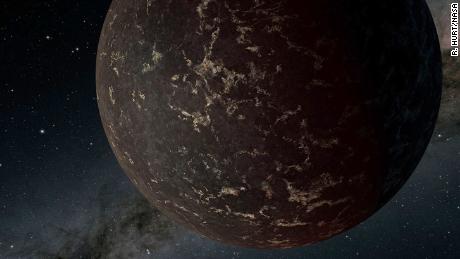
Like Mercury, a nearby 'lava world' is probably lacking an atmosphere
"This is a surprising conclusion," Olson said. "It shows us that conditions on some exoplanets with favorable ocean circulation patterns could be better suited to support life that is more abundant or more active than life on Earth."
NASA has said that the best chance for finding life elsewhere in our own solar system could be on ocean worlds like Jupiter's moon Europa and Saturn's moon Enceladus. But the search for life has largely involved seeking out exoplanets within the habitable zone of the stars they orbit, existing at just the right distance for a surface temperature that can support liquid water on the surface.
"NASA's search for life in the universe is focused on so-called habitable zone planets, which are worlds that have the potential for liquid water oceans. But not all oceans are equally hospitable -- and some oceans will be better places to live than others due to their global circulation patterns," Olson said. "These are the conditions we need to look for on exoplanets."
Investigating exoplanets has to happen from afar because with current technology, we can't reach them. Telescopes can help determine what the conditions might be like on exoplanets, but that data also has to be applied to models of potential climates and evolution that takes place on planets different from our own. Combined, data and models can inform scientists of which planets could host life.
Current telescopes can't identify exoplanets to test Olson's theory, but ideally this finding could help in developing future telescopes that could seek out types of exoplanets defined in this research.
"There will always be limitations to our technology, so life is almost certainly more common than 'detectable' life," Olson said. "This means that in our search for life in the universe, we should target the subset of habitable planets that will be most favorable to large, globally active biospheres because those are the planets where life will be easiest to detect -- and where non-detections will be most meaningful."
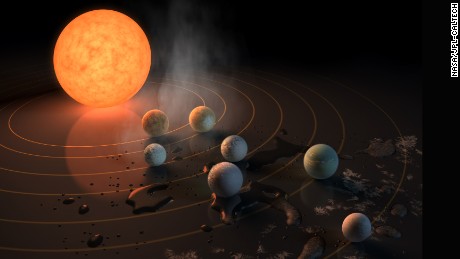
New telescope could look for atmospheres around these exoplanets in a year
This finding continues the interesting work being done around ocean worlds.
"We expect oceans to be important in regulating some of the most compelling remotely detectable signs of life on habitable worlds, but our understanding of oceans beyond our solar system is currently very rudimentary," said Chris Reinhard, a Georgia Institute of Technology professor who was not involved in the study. "Dr. Olson's work represents a significant and exciting step forward in our understanding of exoplanet oceanography."

Let's block ads! (Why?)


https://www.cnn.com/2019/08/23/world/exoplanets-diverse-life-scn-trnd/index.html

2019-08-23 20:15:00Z
52780361339315

NASA's Artemis Moon Program Just Photobombed a Spacewalk (Photo) - Space.com

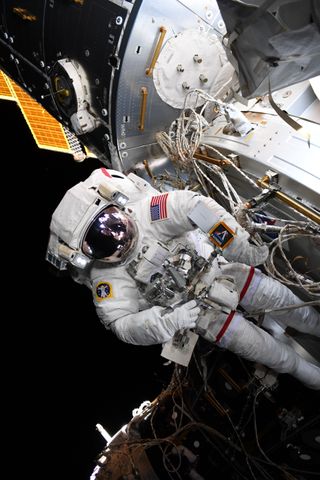
NASA's mission patch for the Artemis moon program saw space for the first time during a dramatic spacewalk earlier this week.

The agency, which plans to send crews to the moon's surface by 2024, unveiled the new logo last month. NASA astronauts Nick Hague and Drew Morgan conducted the first spacewalk since then on Wednesday (Aug. 21), with Hague showing off the patch that those future moon landers will wear.

NASA astronaut Nick Hague sports an Artemis program logo during his spacewalk on Aug. 22, 2019.

(Image credit: NASA)

The patch shows a dramatic white "A" floating in black space above a blue horizon that represents Earth. A red ribbon, which denotes the new crews' path to the moon, flows from Earth's horizon to a small, white moon near the back of the patch.

Related: The Spacewalks of Expedition 59 in Photos

"The work happening now is paving the way for the future," NASA said in a statement. "We are going to the moon to stay, by 2024. NASA's Artemis lunar exploration program will send the first woman and the next man to [the] surface of the Moon within five years, and prepare for human exploration of Mars."

Morgan and Hague took a picture of the patch (with Hague holding it) during their 6-hour-and-32-minute spacewalk to install a new International Docking Adapter (IDA) on the International Space Station. The IDA is the second adapter specifically designed to allow commercial crew vehicles from SpaceX and Boeing to dock with the space station and use ports of entry originally designed for the now-retired space shuttle.

The new dock will also be used by visiting cargo vehicles and possibly by future private flights to the space station, NASA has said. But the most pressing use will be for the first crewed commercial vehicles, which may arrive at the space station as soon as this year if all goes according to plan.

The Artemis program's first major mission is an uncrewed loop around the moon that is expected to fly no earlier than 2020, with test crewed missions expected later in the 2020s.

Follow Elizabeth Howell on Twitter @howellspace. Follow us on Twitter @Spacedotcom and on Facebook. 

Let's block ads! (Why?)


https://www.space.com/astronaut-artemis-moon-patch-on-spacewalk.html

2019-08-23 19:11:00Z
52780360949356

Exoplanets could host abundant life – even BETTER than Earth, scientists discover - RT

Exoplanets in our universe may be home to abundant life that enjoys a more hospitable home than we do on Earth, surprising research has revealed. The news may help in the search for alien life.

Researchers are looking for oceans on exoplanets which have “the greatest capacity to host globally abundant and active life,”said geophysicist Stephanie Olson from the University of Chicago. 

Also on rt.com NASA discovers ‘first nearby super-Earth’ which could be ripe for human colonization

Her team used special NASA software to model a range of exoplanets to see which would be most likely to develop and sustain life. This led to a “surprising conclusion,” which revealed “conditions on some exoplanets with favorable ocean circulation patterns could be better suited to support life that is more abundant or more active than life on Earth,” Olson said. 

These oceans have similar upswelling to Earth’s, and because this creates an upward flow of nutrients from the depths of oceans to the sunlit portions where photosynthetic life lives, meaning there is a nutrient resupply and more biological activity. 

Also on rt.com ‘Hot Saturn’ exoplanet 60 times bigger than Earth discovered

The research found that thicker atmospheres, slower rotations and the presence of continents all created higher upswelling rates.

The new research will help extend the current parameters used in the search for habitable exoplanets, which currently focus on temperatures and the potential for liquid oceans. “Not all oceans are equally hospitable,” Olson explains, “and some oceans will be better places to live than others due to their global circulation patterns.”

Scientists have estimated that up to 35 percent of all known exoplanets that are bigger than Earth should be rich in water, so there’s plenty of potential out there. 

Think your friends would be interested? Share this story!

Let's block ads! (Why?)


https://www.rt.com/news/467135-exoplanet-ocean-life-earth/

2019-08-23 11:24:00Z
52780361339315

Kamis, 22 Agustus 2019

Images from the surface of asteroid Ryugu show rocks similar to carbonaceous chondrite meteorites - Science Magazine

R. Jaumann

German Aerospace Center (DLR), Institute of Planetary Research, Berlin, Germany.Free University of Berlin, Institute of Geosciences, Berlin, Germany.

N. Schmitz

German Aerospace Center (DLR), Institute of Planetary Research, Berlin, Germany.

T.-M. Ho

DLR, Institute of Space Systems, Bremen, Germany.

S. E. Schröder

German Aerospace Center (DLR), Institute of Planetary Research, Berlin, Germany.

K. A. Otto

German Aerospace Center (DLR), Institute of Planetary Research, Berlin, Germany.

K. Stephan

German Aerospace Center (DLR), Institute of Planetary Research, Berlin, Germany.

S. Elgner

German Aerospace Center (DLR), Institute of Planetary Research, Berlin, Germany.

K. Krohn

German Aerospace Center (DLR), Institute of Planetary Research, Berlin, Germany.

F. Preusker

German Aerospace Center (DLR), Institute of Planetary Research, Berlin, Germany.

F. Scholten

German Aerospace Center (DLR), Institute of Planetary Research, Berlin, Germany.

J. Biele

DLR, Microgravity User Support Center, Linder Höhe, Cologne, Germany.

S. Ulamec

DLR, Microgravity User Support Center, Linder Höhe, Cologne, Germany.

C. Krause

DLR, Microgravity User Support Center, Linder Höhe, Cologne, Germany.

S. Sugita

Department of Earth and Planetary Science, School of Science, University of Tokyo, Tokyo 113-0033, Japan.

K.-D. Matz

German Aerospace Center (DLR), Institute of Planetary Research, Berlin, Germany.

T. Roatsch

German Aerospace Center (DLR), Institute of Planetary Research, Berlin, Germany.

R. Parekh

German Aerospace Center (DLR), Institute of Planetary Research, Berlin, Germany.Free University of Berlin, Institute of Geosciences, Berlin, Germany.

S. Mottola

German Aerospace Center (DLR), Institute of Planetary Research, Berlin, Germany.

M. Grott

German Aerospace Center (DLR), Institute of Planetary Research, Berlin, Germany.

P. Michel

Université Côte d’Azur, Observatoire de la Côte d’Azur, Centre National de la Recherche Scientifique, Laboratoire Lagrange, Nice, France.

F. Trauthan

German Aerospace Center (DLR), Institute of Planetary Research, Berlin, Germany.

A. Koncz

German Aerospace Center (DLR), Institute of Planetary Research, Berlin, Germany.

H. Michaelis

German Aerospace Center (DLR), Institute of Planetary Research, Berlin, Germany.

C. Lange

DLR, Institute of Space Systems, Bremen, Germany.

J. T. Grundmann

DLR, Institute of Space Systems, Bremen, Germany.

M. Maibaum

DLR, Microgravity User Support Center, Linder Höhe, Cologne, Germany.

K. Sasaki

DLR, Institute of Space Systems, Bremen, Germany.

F. Wolff

DLR, Institute of System Dynamics and Control, Oberpfaffenhofen, Germany.

J. Reill

DLR, Institute of Robotics and Mechatronics, Oberpfaffenhofen, Germany.

A. Moussi-Soffys

Centre National d’Études Spatiales, 18 Avenue E. Belin, Toulouse 31401, France.

L. Lorda

Centre National d’Études Spatiales, 18 Avenue E. Belin, Toulouse 31401, France.

W. Neumann

German Aerospace Center (DLR), Institute of Planetary Research, Berlin, Germany.

J.-B. Vincent

German Aerospace Center (DLR), Institute of Planetary Research, Berlin, Germany.

R. Wagner

German Aerospace Center (DLR), Institute of Planetary Research, Berlin, Germany.

J.-P. Bibring

L’Université de Paris Sud-Orsay, Institut d’Astrophysique Spatiale, Orsay, France.

S. Kameda

Department of Physics, Rikkyo University, 3-34-1 Nishi-Ikebukuro, Toshima, Tokyo 171-8501, Japan.

H. Yano

Institute of Space and Astronautical Science, Japan Aerospace Exploration Agency, Sagamihara, Japan.

S. Watanabe

Institute of Space and Astronautical Science, Japan Aerospace Exploration Agency, Sagamihara, Japan.Department of Earth and Planetary Sciences, Nagoya University Furo-cho Chikusa-ku, Nagoya, Japan.

M. Yoshikawa

Institute of Space and Astronautical Science, Japan Aerospace Exploration Agency, Sagamihara, Japan.

Y. Tsuda

Institute of Space and Astronautical Science, Japan Aerospace Exploration Agency, Sagamihara, Japan.

T. Okada

Institute of Space and Astronautical Science, Japan Aerospace Exploration Agency, Sagamihara, Japan.

T. Yoshimitsu

Institute of Space and Astronautical Science, Japan Aerospace Exploration Agency, Sagamihara, Japan.

Y. Mimasu

Institute of Space and Astronautical Science, Japan Aerospace Exploration Agency, Sagamihara, Japan.

T. Saiki

Institute of Space and Astronautical Science, Japan Aerospace Exploration Agency, Sagamihara, Japan.

H. Yabuta

Department of Earth and Planetary Systems Science, Hiroshima University, Hiroshima, Japan.

H. Rauer

German Aerospace Center (DLR), Institute of Planetary Research, Berlin, Germany.Free University of Berlin, Institute of Geosciences, Berlin, Germany.

R. Honda

Kochi University, Department of Information Science, Akebono, Kochi, Japan.

T. Morota

University of Tokyo, Department of Earth and Planetary Science, Hongo, Bunkyo, Tokyo, Japan.

Y. Yokota

Institute of Space and Astronautical Science, Japan Aerospace Exploration Agency, Sagamihara, Japan.

T. Kouyama

National Institute of Advanced Industrial Science and Technology, Aomi, Koto, Tokyo, Japan.

Let's block ads! (Why?)


https://science.sciencemag.org/content/365/6455/817

2019-08-22 18:01:04Z
52780360851518

For an asteroid, Ryugu has surprisingly little dust on its surface - Science News

Ryugu is a neat freak. The surface of the small, near-Earth asteroid is surprisingly free of dust, observations from Germany’s MASCOT lander show.

The asteroid, thought to have formed from the breakup of a larger body around 700 million years ago, has no atmosphere to protect it from interplanetary dust streaming through the solar system (SN: 4/27/19, p. 4). These miniature missiles pummel exposed space rocks at high speed, breaking down their surfaces into thin layers of dust and dirt, such as those found on the moon and the asteroid Vesta.

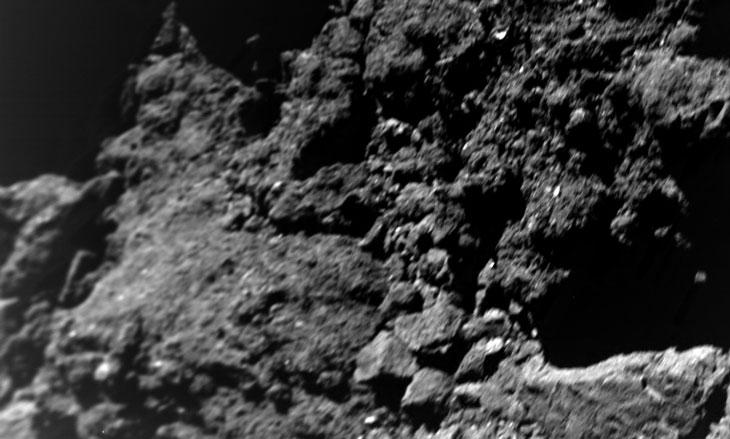
But when MASCOT bounced across Ryugu in October 2018 (SN Online: 9/24/18), the lander took high-resolution photos that show no sign of any dust-sized particles, down to a resolution of about 100 micrometers, about the thickness of a sheet of paper, researchers report in the Aug. 23 Science.

“After a few tens of millions of years, you should have dust on the surface,” says planetary scientist Ralf Jaumann of the German Aerospace Center in Berlin. “If it’s not there, you should have some kind of physical, geological processes which clean up these bodies.”

The MASCOT lander took many pictures as it bounced over Ryugu’s surface, and revealed a rugged terrain largely free of dust.R. Jaumann et al/Science 2019

Ryugu could hide its dust in larger, porous rocks or deep in its interior, Jaumann and colleagues say. Shaking due to a meteorite impact may shuffle the particles into bigger surface rocks or down through small surface cracks to the asteroid’s center and out of sight, the way small nuts end up at the bottom of a cup of trail mix.

Or Ryugu could spray dust into space when sunlight heats patches of trapped ice and releases volatile gases. A similar asteroid, Bennu, seems to spew plumes of small rocks into space, according to NASA’s OSIRIS-REx spacecraft (SN: 4/13/19, p. 10). But Jaumann thinks that explanation is less likely for Ryugu. Observations from the Japanese Hayabusa2 craft, which has been orbiting Ryugu since June 2018 and brought MASCOT along, suggest that Ryugu has less water in its minerals than Bennu (SN: 1/19/19, p. 6).

There’s another possible explanation for Bennu’s dust sprays, says OSIRIS-REx principal investigator Dante Lauretta of the University of Arizona. He thinks frequent temperature changes on Bennu’s surface as the different sides of the asteroid rotate in and out of sunlight could make the asteroid’s larger rocks fracture like a snapped cracker, spraying crumbs into space.

If something similar happens on Ryugu, “then Ryugu should also be ejecting particles,” he says. Hayabusa2 may just not be in the right position to see the sprays. “It would be very cool if we saw it.”

But snapping rocks might create more dust, not less, he notes. An answer to the mystery may not come until after Hayabusa2 returns to Earth with samples of Ryugu’s surface and subsurface in late 2020 (SN: 8/17/19, p. 14).

Let's block ads! (Why?)


https://www.sciencenews.org/article/asteroid-ryugu-surface-has-surprisingly-little-dust

2019-08-22 18:00:00Z
52780360851518

Maximum mass of lightest neutrino revealed using astronomical big data - Phys.org

neutrino
Credit: CC0 Public Domain

Neutrinos come in three flavours made up of a mix of three neutrino masses. While the differences between the masses are known, little information was available about the mass of the lightest species until now.

It's important to better understand and the processes through which they obtain their as they could reveal secrets about astrophysics, including how the universe is held together, why it is expanding and what dark matter is made of.

First author, Dr. Arthur Loureiro (UCL Physics & Astronomy), said: "A hundred billion neutrinos fly through your thumb from the Sun every second, even at night. These are very weakly interactive ghosts that we know little about. What we do know is that as they move, they can change between their three flavours, and this can only happen if at least two of their masses are non-zero."

"The three flavours can be compared to ice cream where you have one scoop containing strawberry, chocolate and vanilla. Three flavours are always present but in different ratios, and the changing ratio-and the weird behaviour of the particle-can only be explained by neutrinos having a mass."

The concept that neutrinos have mass is a relatively new one with the discovery in 1998 earning Professor Takaaki Kajita and Professor Arthur B. McDonald the 2015 Nobel Prize in Physics. Even so, the Standard Model used by modern physics has yet to be updated to assign neutrinos a mass.

The study, published today in Physical Review Letters by researchers from UCL, Universidade Federal do Rio de Janeiro, Institut d'Astrophysique de Paris and Universidade de Sao Paulo, sets an for the mass of the lightest neutrino for the first time. The particle could technically have no mass as a lower limit is yet to be determined.

The team used an innovative approach to calculate the mass of neutrinos by using data collected by both cosmologists and particle physicists. This included using data from 1.1 million galaxies from the Baryon Oscillation Spectroscopic Survey (BOSS) to measure the rate of expansion of the universe, and constraints from particle accelerator experiments.

"We used information from a variety of sources including space- and ground-based telescopes observing the first light of the Universe (the ), exploding stars, the largest 3-D map of galaxies in the Universe, particle accelerators, nuclear reactors, and more," said Dr. Loureiro.

"As neutrinos are abundant but tiny and elusive, we needed every piece of knowledge available to calculate their mass and our method could be applied to other big questions puzzling cosmologists and particle physicists alike."

The researchers used the information to prepare a framework in which to mathematically model the mass of neutrinos and used UCL's supercomputer, Grace, to calculate the maximum possible mass of the lightest neutrino to be 0.086 eV (95% CI), which is equivalent to 1.5 x 10-37 Kg. They calculated that three neutrino flavours together have an upper bound of 0.26 eV (95% CI).

Second author, Ph.D. student Andrei Cuceu (UCL Physics & Astronomy), said: "We used more than half a million computing hours to process the data; this is equivalent to almost 60 years on a single processor. This project pushed the limits for big data analysis in cosmology."

The team say that understanding how neutrino mass can be estimated is important for future cosmological studies such as DESI and Euclid, which both involve teams from across UCL.

The Dark Energy Spectroscopic Instrument (DESI) will study the large scale structure of the universe and its dark energy and contents to a high precision. Euclid is a new space telescope being developed with the European Space Agency to map the geometry of the dark Universe and evolution of cosmic structures.

Professor Ofer Lahav (UCL Physics & Astronomy), co-author of the study and chair of the UK Consortiums of the Dark Energy Survey and DESI said: "It is impressive that the clustering of galaxies on huge scales can tell us about the mass of the lightest neutrino, a result of fundamental importance to physics. This new study demonstrates that we are on the path to actually measuring the neutrino masses with the next generation of large spectroscopic galaxy surveys, such as DESI, Euclid and others."

Arthur Loureiro et al., 'On The Upper Bound of Neutrino Masses from Combined Cosmological Observations and Particle Physics Experiments' will be published in Physical Review Letters on Thursday 22 August 2019.


Explore further

Scientists in Germany seek to find mass of neutrino

More information: On The Upper Bound of Neutrino Masses from Combined Cosmological Observations and Particle Physics Experiments, arXiv:1811.02578 [astro-ph.CO] arxiv.org/abs/1811.02578

Citation: Maximum mass of lightest neutrino revealed using astronomical big data (2019, August 22) retrieved 22 August 2019 from https://phys.org/news/2019-08-maximum-mass-lightest-neutrino-revealed.html

This document is subject to copyright. Apart from any fair dealing for the purpose of private study or research, no part may be reproduced without the written permission. The content is provided for information purposes only.

Let's block ads! (Why?)


https://phys.org/news/2019-08-maximum-mass-lightest-neutrino-revealed.html

2019-08-22 15:00:18Z
52780361010870

Rabu, 21 Agustus 2019

EVA-55 installing second IDA to allow for additional commercial crew vehicle options - NASASpaceflight.com

EVA-55 installing second IDA to allow for additional commercial crew vehicle options - NASASpaceFlight.com

Let's block ads! (Why?)


https://www.nasaspaceflight.com/2019/08/eva-55-ida-additional-commercial-crew-options/

2019-08-21 12:29:10Z
52780359407986