Sabtu, 29 Juni 2019

Breathtaking astronomical alignment to captivate millions on Tuesday - AccuWeather.com

[unable to retrieve full-text content]

  1. Breathtaking astronomical alignment to captivate millions on Tuesday  AccuWeather.com
  2. Total Solar Eclipse 2019: Path, Viewing Maps and Photo Guide  Space.com
  3. Total solar eclipse will plunge parts of South America into darkness  Fox News
  4. How to watch the July 2 solar eclipse from anywhere in the world  CNET
  5. Eclipse 2019 totality: How long will the solar eclipse last? Where is path of totality?  Express.co.uk
  6. View full coverage on Google News

https://www.accuweather.com/en/weather-news/breathtaking-astronomical-alignment-to-captivate-millions-on-tuesday/70008687

2019-06-29 18:44:00Z
52780322554404

Total Solar Eclipse 2019: Path, Viewing Maps and Photo Guide - Space.com

On July 2, a solar eclipse will sweep across the South Pacific and parts of South America. 

In parts of Chile and Argentina, skywatchers will witness a total eclipse of the sun, in which the moon will block the sun from view — with the exception of its wispy corona. In other parts of South America, skywatchers can see a partial eclipse, and the sun will look like the moon took a "bite" out of its face. 

With this photo guide, you can find out exactly where the eclipse will be visible and what it will look like. If you're not in the path of the eclipse, be sure to check out these eclipse webcasts from various observatories in its path. 

Related: Total Solar Eclipse 2019: A Complete Guide


Visibility Map

(Image credit: NASA's Scientific Visualization Studio)

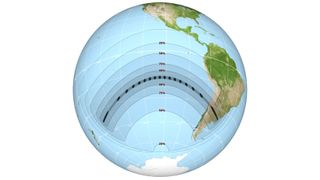
This map represents the path that the moon's shadow will take across the Earth's surface during the total solar eclipse. Outside the path of totality, this map shows the percentage of the sun's disk that will be covered by the moon at maximum partial eclipse. 

Before the eclipse reaches South America, it will first pass over a few remote islands in the Pacific Ocean. The first place to see the eclipse will be Oeno Island, which will experience 2 minutes and 53 seconds of totality starting at 10:24 a.m. local time (1824 GMT). Totality will narrowly miss Easter Island, where skywatchers will see the moon cover up to about 80% of the sun's disk. 

The moment of greatest eclipse will occur at a point about 1,600 miles (2,600 km) southwest of Isla Isabela of the Galapagos Islands, where totality lasts a whopping 4 minutes and 32.8 seconds. Unfortunately, that's happening over open water, so unless there's an airplane or boat passing though, there won't be any humans around to see it. 

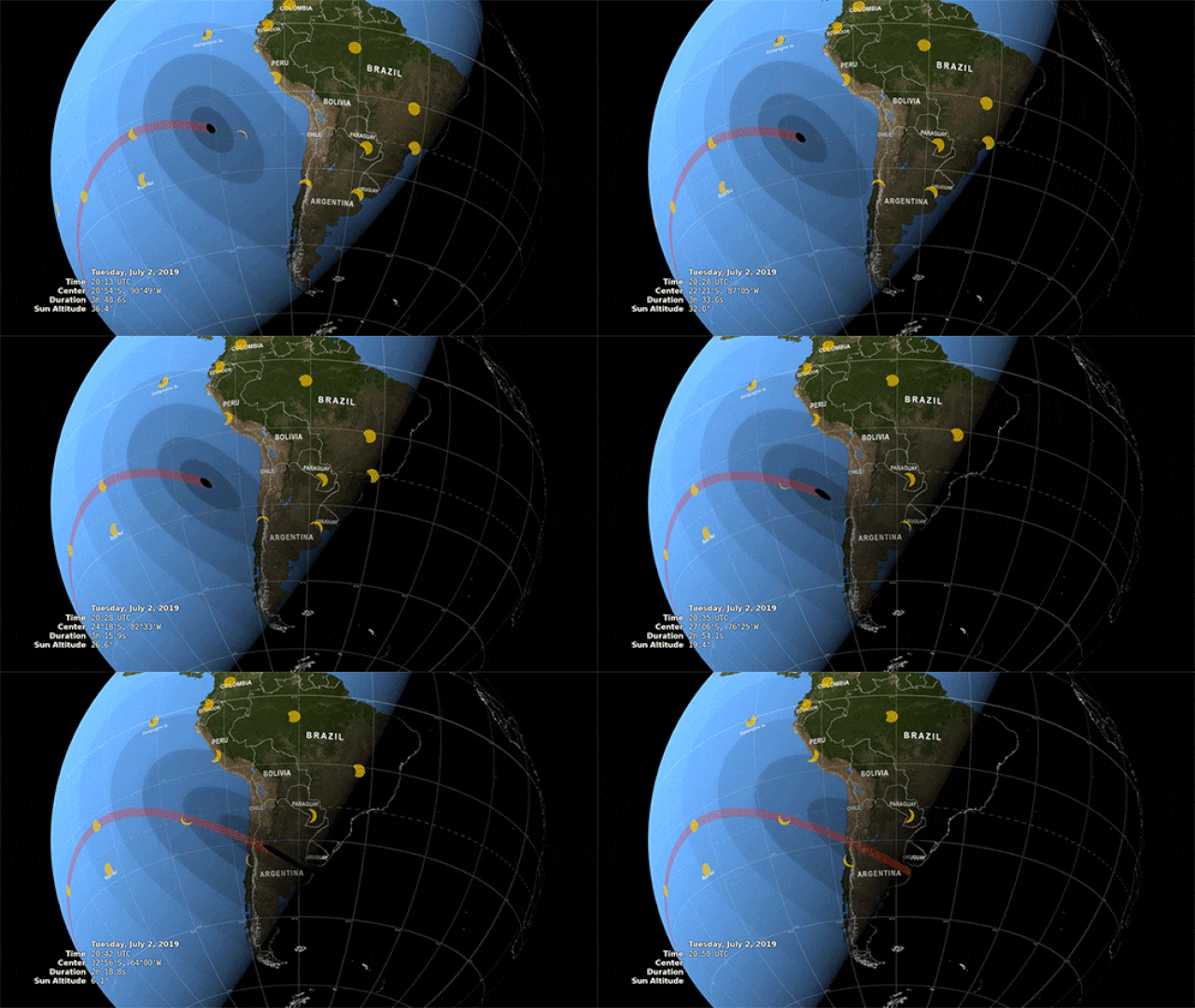
Eclipse Animation

(Image credit: NASA's Scientific Visualization Studio)

An animation of the total solar eclipse on July 2 shows the path the moon's shadow will take across the South Pacific Ocean and South America.

Totality in South America

(Image credit: NASA's Scientific Visualization Studio)

A more detailed map shows the path of totality across Chile and Argentina. Here you can see features including national boundaries, major roads and cities along the path. The shape of the umbra, or the inner part of the moon's shadow, is shown at 3-minute intervals and labeled with the local time zones at its center.

Totality will make its first landfall in South America near La Serena, Chile. The partial eclipse there begins at 3:15 p.m. local time (1915 GMT), and totality begins at 4:38 p.m. local time (2038 GMT). La Serena will experience 2 minutes and 17 seconds of totality.

From there, the eclipse will move southeast across Chile and into Argentina before disappearing into the sunset just south of Montevideo, Uruguay. Most of South America will see at least a partial eclipse, but the path of totality is only about 95 miles (150 kilometers) wide. 

To find out the exact circumstances of the eclipse's visibility from a specific location, check out this interactive map by timeanddate.com

Path of Totality in Chile

(Image credit: ESO/P. Horálek/M. Druckmüller/P. Aniol/Z. Hoder/S. Habbal/L. Calçada)

This chart shows how the eclipse will appear from different locations in Chile. To the right is an artist's impression of totality over the European Southern Observatory's La Silla Observatory, which is located north of La Serena in Chile's Atacama Desert.

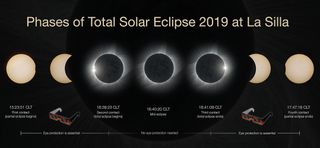
Stages of the Eclipse

(Image credit: ESO/P. Horálek/M. Druckmüller/P. Aniol/Z. Hoder/S. Habbal)

This timeline shows how and when the phases of the total solar eclipse will progress as seen from the La Silla Observatory. 

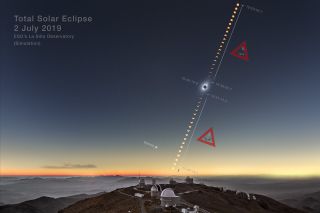
Eclipse Progression Over La Silla

(Image credit: ESO/B. Tafreshi (twanight.org)/P. Horálek)

This ESO infographic shows the predicted path of the eclipsed sun in the sky above La Silla. The partial phase of the eclipse will end just before sunset there. Farther east, the sun will set before the eclipse is over.  

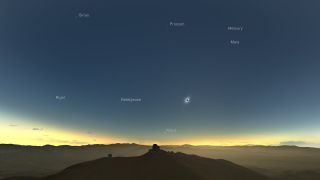
Visible Planets and Stars

(Image credit: M. Druckmüller, P. Aniol, K. Delcourte, P. Horálek, L. Calçada/ESO)

During totality, the sky will darken enough to reveal planets and stars that are not otherwise visible from the Southern Hemisphere this time of year, because they're above the horizon during the daytime. 

Of course, you'll want to spend your totality looking at the eclipsed sun. But if a cloud happens to block your view of the corona, these are still a good reason to keep looking up! 

Be sure to check our eclipse skywatching guide for more details about the visible stars and planets. 

How to Observe the Sun Safely

(Image credit: Karl Tate, Space.com Contributor)

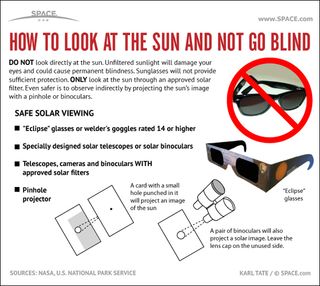
You should never look directly at the sun, but there are ways to safely observe an eclipse. See how to safely observe a solar eclipse with this Space.com infographic.

Read more eclipse-observing tips here:

A Solar Eclipse Can Blind You (Read This Before Looking at the Sun!)

Solar Eclipse Glasses: Where to Buy the Best, High-Quality Eyewear

Things I Used to Observe an Eclipse, Rated

Eclipses to Come

(Image credit: T. Matsopulos/NASA)

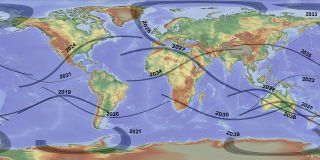
If you missed this year's total solar eclipse, it's not too late to start planning for the next one! Here's a map of all the total solar eclipses coming up until the year 2040. 

Email Hanneke Weitering at hweitering@space.com or follow her @hannekescience. Follow us on Twitter @Spacedotcom and on Facebook.

Let's block ads! (Why?)


https://www.space.com/total-solar-eclipse-2019-photos.html

2019-06-29 16:40:00Z
52780322554404

Classified Apollo 11 anomaly threatened to crash first moon astronauts - INSIDER

Apollo 11 is rightfully hailed as an extraordinary success for the US. After all, NASA rocketed humans to the moon's surface for the first time and brought them home alive.

But there were quite a few close calls during the historic mission that could have ended it in tragedy.

Minutes ahead of the moon landing, for instance, alarms blared inside the lunar-landing spacecraft, indicating that the flight computer was overloaded and might quit. Then a surprise crater threatened to botch the landing, so Neil Armstrong and Buzz Aldrin (the two moonwalkers) used up nearly all of their fuel navigating to safer lunar pastures.

These and other stories — frozen fuel lines, a stuck hatch, a busted switch required to leave the moon — are well-shared among spaceflight enthusiasts and historians.

But according to a forthcoming book, the mission's three astronauts may have been in far more peril than previously reported.

A serious anomaly occurred as the crew careened toward a landing on Earth, according to Nancy Atkinson, a science journalist and author who details formerly classified information about the event in her new book, " Eight Years to the Moon: The History of the Apollo Missions."

"Through my interviews and research for the book, I uncovered a serious anomaly that occurred during Apollo 11's return to Earth," Atkinson — whose book comes out July 2 — told Business Insider in an email. "The event was discovered only after the crew had returned safely to Earth."

The problem happened just before Apollo 11 returned to Earth, causing a discarded space module to nearly crash into the crew's capsule.

What's more, Atkinson's sources suggest, the same issue also threatened the crews of three other Apollo missions.

'We were lucky'

The main spacecraft that NASA used during the Apollo moon-landing program. Astronauts left the lunar module on the moon, broke away from the service module during landing, and splashed into the ocean inside the command module.
NASA; Business Insider

The anomaly happened less than an hour before the Apollo 11 crew landed. As Atkinson tells it, most everyone at NASA did not realize the peril it put astronauts in until weeks after they'd returned to Earth.

For most of their eight-day mission, the crew of Apollo 11 rode inside a gumdrop-shaped capsule called the command module. This capsule sat on top of the service module: a large cylinder that carried supplies, propellants, and a large rocket engine. NASA called the two-part spacecraft the command and service module, or CSM.

The CSM delivered a third part, called the lunar module, to lunar orbit. Then that lander took Aldrin and Armstrong to and from the surface, while astronaut Michael Collins remained in orbit around the moon. The CSM then rocketed everyone back toward Earth on a three-day voyage.

About 15 minutes before the astronauts splashed into the Pacific Ocean, the CSM fully separated into its two parts. This was necessary because only the command module (which held the crew) had a heat shield. The heat shield protected the astronauts by deflecting and absorbing the scorching energies created by plowing through Earth's atmosphere at about 25,000 mph — more than a dozen times as fast as a speeding bullet.

A line drawing illustrating the Apollo 14 Command and Service Modules changes following the Apollo 13 near-disaster.
NASA
The service module became useless and posed a collision risk after the two parts separated, so it was supposed to skip off Earth's atmosphere like a stone thrown across a pond.

But it did not.

Read more: An Apollo astronaut explains how he nearly killed himself 'horsing around' on the moon in 1972

Instead, as Atkinson explains, the service module chased the astronauts during their descent.

"Houston, we got the service module going by. A little high and a little bit to the right," Aldrin, who was looking out of the command module's window, told Mission Control over the radio.

Moments later he added: "It's coming across now from right to left."

As plasma built up ahead of the capsule, its radio communications temporarily went out (as expected) yet prevented the astronauts from offering any more details. But an airplane pilot spotted the returning command module and service module, the latter of which was breaking apart and splintering into glowing pieces.

Gary Johnson, who worked as an electrical engineer on the Apollo program, told Atkinson that the service module should have been "absolutely nowhere close to the command module" as it descended.

If the part had collided with the command module carrying the astronauts, it could have crippled or destroyed the vehicle or sent it flying out of control. Chunks of the disintegrating service module could also have struck the capsule, which could have led to catastrophe as well, Atkinson wrote.

"If things had gone bad, we could have lost the Apollo 11 crew," Johnson told Atkinson. "We were lucky."

Why the Apollo jettison anomaly isn't well known

Apollo 11's command module and service module careen back to Earth at thousands of miles per hour, creating superheated plasma in the process, on July 24, 1969. Most of the lights are pieces of the disintegrating service module.
NASA/JSC via Smithsonian Institution

The astronauts, mission controllers, and communications personnel didn't understand there was a problem until after NASA debriefed the three moon men about their mission weeks later.

NASA launched an investigation based on their reports and found that two prior missions — Apollo 8 and Apollo 10 — had suffered the same glitch. Those astronauts did not see the service module outside their windows, however, so they didn't report it, Atkinson wrote. (A review of old radar recordings showed the service modules on those missions did also fly dangerously close to the command modules, though.)

The problem's cause turned out to be a bad sequence in a controller that helped jettison, or separate, the command and service modules. NASA knew the same problem was baked into the Apollo 12 spacecraft, which launched in November 1969, but decided not to fix it due to time constraints, Atkinson said.

According to Johnson, NASA kept the Apollo 11 astronaut debriefs classified until November 1970 — about six months after the harrowing Apollo 13 mission — and the anomaly stayed out of newspapers.

"The event never made it into the Apollo 11 mission reports and somehow was largely forgotten — I think due to the frantic-ness of the time, of needing to move on to the next flight, etc.," Atkinson said. "The first time the fix for this anomaly was in place was for Apollo 13. And of course, you know what happened with 13, and I think the anomaly was probably largely forgotten due to all the other excitement."

More details about the anomaly can be found in Atkinson's book.

Let's block ads! (Why?)


https://www.insider.com/classified-apollo-11-anomaly-threatened-to-crash-first-moon-astronauts-2019-6

2019-06-29 12:58:54Z
52780322691971

Jumat, 28 Juni 2019

Apollo 11 tapes bought for $218 may sell for millions after nearly being lost - The Guardian

[unable to retrieve full-text content]

  1. Apollo 11 tapes bought for $218 may sell for millions after nearly being lost  The Guardian
  2. Apollo astronaut Charlie Duke says he almost died jumping on moon  Business Insider
  3. 50 years after Apollo, NASA prepares for return trip to the moon  Houston Chronicle
  4. How the space program created the culture of learning from failure  Fast Company
  5. Apollo moon rocks help us understand our place in the cosmos  Vox.com
  6. View full coverage on Google News

https://www.theguardian.com/science/2019/jun/28/apollo-11-tapes-moon-landing-sale-value-nearly-lost

2019-06-28 15:50:00Z
52780322691971

NASA’s restored Apollo Mission Control is a slice of 60s life, frozen in amber - Ars Technica

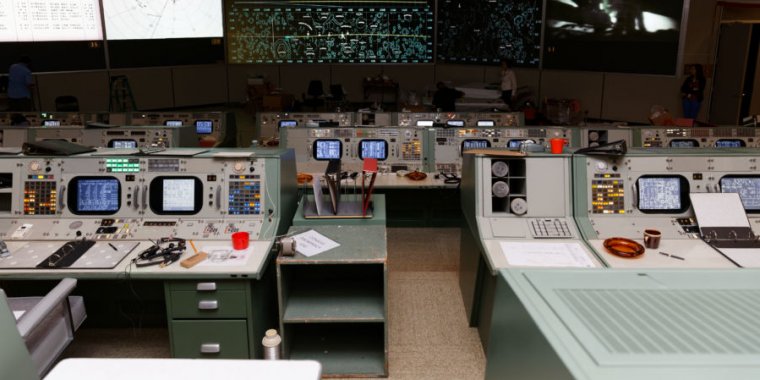
HOUSTON—Following the completion of a multi-year, multi-million-dollar restoration, NASA's historic Apollo Mission Operations Control Room 2 ("MOCR 2") is set to reopen to the public next week. The $5 million in funding for the restoration was partially provided by NASA, but the majority of the money was donated by the city of Webster, the Houston suburb where the Johnson Space Center is located. Another half-million in funding came from the general public via a Kickstarter campaign (disclosure: your humble author was a backer).

For the past two years, historians and engineers from the Kansas Cosmosphere's Spaceworks team have been lovingly restoring and detailing the 1,200-pound (544kg) historic sage green Ford-Philco consoles that populated the control room—repairing damage from decades of casual neglect and also adding in the correct control panels so that each console now correctly mirrors how it would have been configured for an Apollo flight.

Ars was invited to view the restored MOCR 2 last week as the final finishing restoration touches were still being applied. We conducted some interviews and shot some photos while technicians and construction workers bustled around us, hammering and screwing the last bits and bobs into place. The room's lighting system was in the process of being worked on, and the room flickered several times between fully illuminated daytime lighting and dim twilight—providing an even more accurate glimpse of what it might have looked like during an actual mission.

How we got to now

Today, the Mission Control Center in JSC's Building 30 (renamed a few years ago to the "Chris Kraft Mission Control Center" to honor Christopher Columbus Kraft Jr., the person most directly responsible for defining how NASA's Mission Control would come to function) includes multiple Flight Control Rooms, referred to in NASA shorthand as FCRs ("fickers"). But during the Apollo era, there were two control rooms in the building—Mission Operations Control Room 1, on the second floor, and Mission Operations Control Room 2, on the third floor (referred to as MOCR 1 and MOCR 2, it's pronounced "mo'-ker"). MOCR 1 was only used for a few flights prior to the shuttle era and was primarily used for simulations and as a backup. MOCR 2, on the other hand, was where controllers sat and ran every Apollo flight except for Apollo 7. "The Eagle has landed" and "Houston, we've had a problem" both happened in MOCR 2. After Apollo, the room served as a shuttle FCR until 1992, when it was converted back to something resembling its early Apollo configuration and transformed into a tour stop. It was also used for other NASA events—personnel could book the room for meetings or show movies there. It was a frequent stop for VIP visitors and media who wanted to do something Apollo-related (Ars included, more than once!), and over the decades, the room slowly deteriorated. The carpet was stained and bare. The paint faded. And the consoles themselves, the objects of so much studious attention from generations of flight controllers, sat dark and silent. Random visitors could even run hands over the artifacts, casually pressing buttons and toggling switches that once perhaps were used for life-and-death purposes.

But with the 50th anniversary of the Apollo 11 landing fast approaching in 2019, NASA finally had the ammunition it needed to push for the restoration—and now MOCR 2 shines like new.

Let's block ads! (Why?)


https://arstechnica.com/science/2019/06/behind-the-scenes-at-nasas-newly-restored-historic-apollo-mission-control/

2019-06-28 13:41:00Z
CBMicmh0dHBzOi8vYXJzdGVjaG5pY2EuY29tL3NjaWVuY2UvMjAxOS8wNi9iZWhpbmQtdGhlLXNjZW5lcy1hdC1uYXNhcy1uZXdseS1yZXN0b3JlZC1oaXN0b3JpYy1hcG9sbG8tbWlzc2lvbi1jb250cm9sL9IBeGh0dHBzOi8vYXJzdGVjaG5pY2EuY29tL3NjaWVuY2UvMjAxOS8wNi9iZWhpbmQtdGhlLXNjZW5lcy1hdC1uYXNhcy1uZXdseS1yZXN0b3JlZC1oaXN0b3JpYy1hcG9sbG8tbWlzc2lvbi1jb250cm9sLz9hbXA9MQ

Future - Apollo in 50 numbers: Food - BBC News

170: Weight of breakfast steaks eaten by astronauts, in grams

Every Nasa astronaut since Alan Shepard in 1961 has been given a hearty breakfast before blast-off. All the pre-flight Apollo meals were specially prepared for nutrition, calories and – crucially – were what doctors refer to as "low residue". In other words, low-fibre meals that wouldn’t have astronauts needing the toilet too soon after lift-off.

Early missions also limited coffee intake before launch, because of its diuretic properties. Shepard’s Mercury flight, for instance, was only 15 minutes so doctors figured that he could avoid urinating until splashdown. Unfortunately, they did not account for countdown delays.

“They put Alan Shepard on top of his rocket without a way to take a leak,” says reporter Jay Barbree, who was commentating on the mission for US TV channel NBC. “After two hours, he starts complaining and desperately asks for permission to wet his suit – finally they gave him permission.” The astronaut is relieved but the medical sensors go crazy.

Astronauts flying in the Apollo spacecraft used personal urine collection devices – like condoms – which were connected to a disposal system, which ejected the waste from a port on the side of the spacecraft. 

You might also like:

Solid waste involved using plastic bags and most astronauts tried to avoid going to the toilet for as long as possible. The first to crack during Apollo 7 was Walt Cunningham.

“It was hard to get everything working just right,” he tells me. “You can catch everything but after that you had the get some pills loose from inside the bag and you spend your time mixing the pills up with whatever you had there – it was not terribly fun.”

2,800: Daily calories consumption

The first American to eat a meal in space was John Glenn. During his five-hour flight, he tested out a tube – a bit like a toothpaste tube – of apple puree, proving that people could swallow and digest food in weightlessness.

For the two-man Gemini missions of the mid-1960s, astronauts were allocated 2,500 calories a day and consumed plastic packs of freeze-dried foods produced by the Whirlpool Corporation (the home appliance company). Freeze-drying involved cooking the foods, quickly freezing them and then slowly warming them in a vacuum chamber to remove the ice crystals formed by the freezing process.

The astronauts squirted water through a nozzle to rehydrate the foods and kneaded the resulting paste into some sort of gloop. The meals were tastier than the tube food on Mercury, and included such delights as beef and gravy, but the water was cold, which made them often less than appetizing.

During the first Gemini mission – Gemini 3 in 1965 – John Young created a minor scandal and the only blemish on his exemplary astronaut career, by smuggling a corned beef sandwich on board. What started as a joke threatened to cause a serious problem with the spacecraft, with fears that crumbs would interfere with the spacecraft circuitry.

Not only were the foods tastier, the water gun – supplied from the spacecraft fuel cells – ran hot as well as cold

During the Apollo missions – when the astronauts could do some limited exercise in the capsule and were exerting themselves on the Moon – Nasa nutritionists upped the calorie intake to 2,800.

Not only were the foods tastier, the water gun – supplied from the spacecraft fuel cells – ran hot as well as cold. And the meals didn’t only have to be sucked through a straw, the astronauts could even eat some of them with a spoon. 

6: Packs of pineapple fruit cake

The pantry of the Apollo spacecraft was jammed with snacks. Along with six portions of pineapple fruit cake, there were packs of brownies, chocolate cake and jellied fruit candy. For the savoury palate, there were cheese crackers and BBQ beef bites. Apollo astronauts were even allocated 15 packs of chewing gum, containing four sticks in each.

A typical dinner during Apollo 17 consisted of a main of chicken and rice, followed by butterscotch pudding and ‘Graham Cracker cubes’. They could wash this all down with instant coffee, tea, cocoa or lemonade.

Missions from Apollo 15 onwards also carried less appealing "nutrient defined food sticks". A precursor of today’s nutrition bars, these were positioned within the front of the astronauts’ helmets during their moonwalks alongside a drinking tube. This enabled them to eat and drink – either water or fruit-flavoured beverages – during their extended expeditions on the lunar surface.

Despite the varied diet and increased calories, almost every astronaut lost weight during the missions. Neil Armstrong shed 4kg (8.8lb) during his Apollo 11 flight. During Apollo 13, commander Jim Lovell lost 6kg (13.2lb) – partly because of dehydration due to water rationing.

Since Apollo, food in space has continued to improve. Today’s astronauts eat an almost normal diet although find themselves craving fresh fruit and vegetables – a rare treat available only after supply ships dock.

0: Shots of brandy consumed

Christmas Day 1968, and the crew of Apollo 8 were on their back from the Moon. They had a special surprise ration package to unwrap from the head of the astronaut corps, Deke Slayton. Inside, a full Christmas meal – complete with turkey, gravy and cranberry sauce, and it didn’t even have to be rehydrated.

If anything had gone wrong, it would be blamed on the brandy so we brought it home – Deke Slayton

“It was a new type of food packaging that we hadn't experienced before,” says mission commander Frank Borman. “We had our best meal on the flight on Christmas Day – I was really glad to experience turkey, gravy and all the works.”

But Slayton had also packed another surprise. “He also smuggled on board for us three shots of brandy,” says Borman. “But we didn't drink that.

“If anything had gone wrong, it would be blamed on the brandy so we brought it home,” he says. “I don't know what happened to mine – probably worth a lot of money now.”

Alcohol has been consumed in space – mostly in small quantities by Russian cosmonauts on their early space stations. It’s banned, however, on the International Space Station. Even a small amount could break the station’s complex water recovery system, which is fed with water from astronaut sweat and urine.

15: Microwaveable ready meals eaten by Apollo 11 crew

In the long list of benefits to mankind from the space programme, ready meals might perhaps be an unlikely contender. But without Apollo, the microwave ovens many of us have in our kitchens or the ready meals millions consume every day, might never have been developed.

That’s right… Apollo contributed to the global obesity epidemic.

When Neil Armstrong, Buzz Aldrin and Michael Collins returned from the Moon and were winched aboard USS Hornet, they spent their first few days in the Mobile Quarantine Facility (MQF) to protect the world from any possible Moon bugs. Although the MQF was fitted with comfy chairs, bunks, a toilet and shower, it only had limited room for cooking.

With no room for a conventional oven or grill – and to minimise the dangers of fire – Nasa looked for an innovative solution.

“This is the original countertop microwave oven, developed for the Apollo programme,” says Bob Fish, a trustee of Hornet, now preserved as a museum in Oakland in California.

The microwave proved a big hit allowing the astronauts to reheat three frozen meals a day

“Nasa went to Litton Industries who had developed giant walk-in microwave ovens and asked them to shrink it down so that it could be fit inside a place like this,” says Fish. “So, they shrunk it down, and the first time the guys tried it they put some eggs in there and they hit start – it just exploded the eggs because they hadn't shrunk down the power they only shrunk down the size.”

After these initial teething difficulties, the microwave proved a big hit allowing the astronauts to reheat three frozen meals a day. These included full cooked breakfasts, ribs of beef and even lobster. Desserts included ice cream, pecan pie and cherry cobbler.

Once the astronauts had been air-lifted to Houston and transferred (still under quarantine) to the Lunar Receiving Laboratory, the food stepped-up a notch again. They ate freshly cooked food at tables covered with crisp white table linen.

--

Join more than one million Future fans by liking us on Facebook, or follow us on Twitter or Instagram.           

If you liked this story, sign up for the weekly bbc.com features newsletter, called “If You Only Read 6 Things This Week”. A handpicked selection of stories from BBC Future, Culture, Capital, and Travel, delivered to your inbox every Friday. 

Let's block ads! (Why?)


http://www.bbc.com/future/story/20190627-apollo-in-50-numbers-food

2019-06-28 07:47:55Z
CBMiQmh0dHA6Ly93d3cuYmJjLmNvbS9mdXR1cmUvc3RvcnkvMjAxOTA2MjctYXBvbGxvLWluLTUwLW51bWJlcnMtZm9vZNIBAA

Kamis, 27 Juni 2019

Astronomers discover the source of unexplained cosmic radio burst - CNET

smallerfastradioburst

To discover the source of a one-off, mysterious space signal, an international team of astronomers utilized telescopes around the world.

CSIRO/Dr. Andrew Howells

Astronomers keep hearing unexplained, incredibly powerful signals from the far reaches of space -- signals that come through loud and clear for a thousandth of a second and then mysteriously disappear. First discovered in 2007, "these pulses are known as fast radio bursts", and they remain one of the universe's biggest mysteries. Dozens of the enigmatic cosmic signals have been detected, and astronomers have puzzled over them for the past decade, trying to decode where they come from -- and what causes them. 

In a historic first, an international team of researchers have pinpointed the location of a non-repeating fast radio burst, finding its source originates in the outskirts of a galaxy 4 billion light-years away. 

The monumental findings, published in AAAS journal Science on Thursday, detail the discovery and localization of FRB 180924, a powerful, one-off fast radio burst that lasted for just a fraction of a second. Speculation about the cause of the bizarre signals takes in everything from explosive neutron stars to alien spacecraft, and while we're still not sure what's causing them, the revelation puts astronomers one step closer to their true nature.

"This is the big breakthrough that the field has been waiting for since astronomers discovered fast radio bursts in 2007," said Keith Bannister, lead author of the paper and principal research engineer with Australia's Commonwealth Scientific and Industrial Research Organisation. 

Now playing: Watch this: Aliens and the search for extraterrestrial intelligence

6:23

The burst was picked up by the Australian Square Kilometre Array Pathfinder, which consists of 36 radio telescopes working in tandem to scan the sky and listen for radio signals. Situated in the Australian outback, where there's little radio interference, ASKAP is able to pick up the faintest whispers of the universe. The burst traveled from the other side of the universe, smacking into ASKAP's array -- and within half a second, the machine stopped the search and downloaded the data from each of the 36 dishes. 

The burst hits each dish at slightly different times. In a ridiculous feat of engineering, the team can calculate the difference in arrival time to within one-tenth of a nanosecond. That allows their detective work to begin, tracing the position to a spot in the sky -- essentially plucking a needle from a haystack.

The research team found FRB 180924 had come from a distant galaxy very similar in size to our own Milky Way. Galaxies are huge, huge swirling masses of stars, but the team was able to pinpoint the burst's exact cosmic city block, approximately 13,000 light-years from the center of the galaxy. 

The view from antenna 29 of the the Australian Square Kilometre Array Pathfinder as it listens for deep-space signals.

The view from antenna 29 of the the Australian Square Kilometre Array Pathfinder as it listens for deep-space signals.

CSIRO/Alex Cherney

After locating the burst, the research team used a suite of other telescopes around the world, including the Very Large Telescope and the Gemini South telescope in Chile, as well as the Keck telescope in Hawaii. Getting these extra cosmic eyes trained on the spot allowed the team to further characterize the location.

On only one other occasion, in 2017, has a fast radio burst been traced to its source -- and that particular investigation was slightly easier because the burst repeated itself intermittently, like a strobe light. Known as FRB 121102, or the "repeater," the burst came from a completely different source to FRB180924: a dwarf galaxy slightly around 3 billion light-years away. 

"The burst we localized and its host galaxy look nothing like the 'repeater' and its host," said Adam Deller, an astrophysicist at Swinburne University of Technology.

That suggests non-repeating fast radio bursts might be different from those that do repeat, or it could hint that the signal differs depending on where it comes from. 

"The evidence certainly points to FRBs living in a very wide range of environments. In that sense, it isn't surprising that their bursting properties, whether they repeat or not, would vary widely too," said Bannister.

It's one thing to locate the signal, but it lies so far away from the Earth that it's impossible for us to see exactly what's causing it. For ASKAP, this is only the beginning. Bannister notes that the group is "almost fully armed and operational," and he expects to localize more radio bursts in the future.

"We're continually extending the capabilities of the telescopes and getting better at finding the needles in the haystack," adds Deller. 

With all manner of fantastic explanations put forward for the rare cosmic signals -- magnetars, neutron stars and aliens -- Bannister isn't ruling out extraterrestrial intelligence just yet.

"I think in all likelihood we'll work out a natural explanation for these events, but I like to keep an open mind and follow wherever the evidence leads me."

Updated 3:15 p.m. PT: Added extra comments from researchers

Let's block ads! (Why?)


https://www.cnet.com/news/astronomers-discover-the-source-of-unexplained-cosmic-radio-burst/

2019-06-27 22:15:00Z
CAIiEKfafKA9-i5f0hENI2I3yugqEwgEKgwIACoFCAow4GowoAgwkRo