Senin, 01 April 2019

Curiosity Rover Detected Methane on Mars in 2013, a New Analysis Confirms - Gizmodo

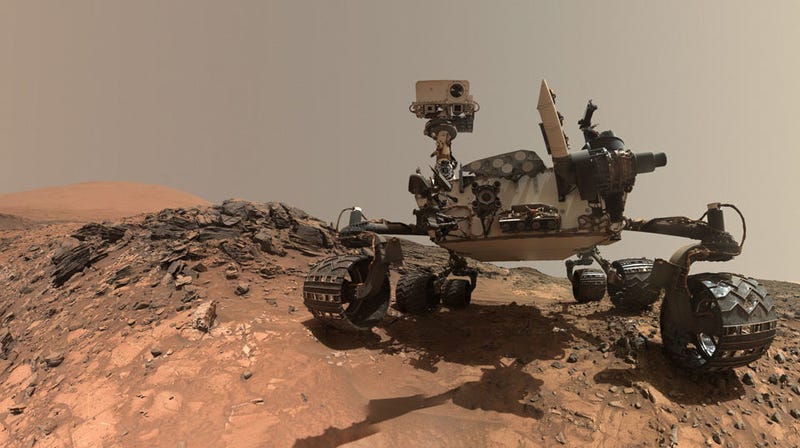
NASA’s Curiosity rover on Mars.
Image: NASA, JPL-Caltech, MSSS

NASA’s Curiosity rover shook the science community six years ago when it apparently detected traces of methane—an important chemical linked to life—on Mars. Researchers failed to confirm these results in the years that followed, but that’s now changed thanks to a re-analysis of data collected from orbit.

New research published today in Nature Geoscience confirms that NASA’s Curiosity rover detected a methane spike on June 15, 2013, while exploring Gale Crater on Mars. The new paper, led by Marco Giuranna from the Institute for Space Astrophysics and Planetology in Rome, Italy, doesn’t explain how methane came to exist on the Red Planet, but the independent confirmation is a potential sign that Mars once featured conditions suitable for life during its ancient past. More radically, it suggests microbial life once existed on Mars, producing the smelly gas that’s now escaping from the planet’s bowels.

Advertisement

That methane might exist on Mars is an issue of considerable debate. Methane is a key requirement of habitability, and possibly even a signature of life itself. The trouble with methane, however, is that it doesn’t last long in the atmosphere. Any methane that is detected would therefore have been released relatively recently. For Mars, this means the gas is likely venting up from beneath the surface. What’s more, the sporadic, intermittent nature of these apparent methane spikes suggests the methane is being released at irregular intervals.

Proving that methane exists on Mars would be a huge deal, so scientists have been extra careful to avoid any missteps in this area. The Curiosity detection from 2013 was intriguing, but because the observation could not be corroborated by other instruments, such as in-orbit satellites, it could not be definitively confirmed.

Advertisement

Confirmation of the Curiosity measurement has now happened owing to a re-analysis of data collected by the European Space Agency’s Mars Express orbiter at the time. Specifically, data collected by the spacecraft’s Planetary Fourier Spectrometer on June 16, 2013, when it was above Gale Crater, are in accordance with measurements taken by Curiosity the day before. It’s the first time that measurements made on the ground have been confirmed by a spacecraft in orbit, according to an ESA statement.

Giuranna and his colleagues confirmed the Curiosity observation by looking at 20 months of data collected by Mars Express, and also by developing a new technique that allowed the researchers to scour through hundreds of measurements made over a single area. Interestingly, Mars Express detected no other methane spikes during the observational period aside from the one detected by Curiosity.

“In general we did not detect any methane, aside from one definite detection of about 15 parts per billion by volume of methane in the atmosphere, which turned out to be a day after Curiosity reported a spike of about six parts per billion,” said Giuranna in a statement “Although parts per billion in general means a relatively small amount, it is quite remarkable for Mars—our measurement corresponds to an average of about 46 tonnes of methane that was present in the area of 49,000 square kilometres observed from our orbit.”

Advertisement

At the time of the Curiosity observation, scientists figured the methane originated north of the rover and was carried to the Gale Crater by southerly winds. The new interpretation presented in the new study offers a different scenario. The quantity of methane detected, along with the geology of the area, suggests the methane spike occurred within Gale Crater itself. Two independent analyses were used to reach this conclusion, including computer simulations that assessed the probability of methane emissions from the Martian surface, and the identification of geological features within Gale Crater consistent with the associated methane spike.

The hypothesized methane cycle on Mars, showing how the gas is created and destroyed.
Image: ESA

This kind of thing happens on Earth, typically along tectonic faults and at natural gas deposits. Something similar may be happening on Mars, in this case, along the faults of the Aeolis Mensae region.

Advertisement

“We identified tectonic faults that might extend below a region proposed to contain shallow ice,” study co-author Giuseppe Etiope from the National Institute of Geophysics and Volcanology said in the ESA statement. “Remarkably, we saw that the atmospheric simulation and geological assessment, performed independently of each other, suggested the same region of provenance of the methane.”

The researchers theorize that the methane detected on Mars is being caused by small, transitory geological events, rather than a process in which the gas is constantly being replenished in the Martian atmosphere. There’s still much to learn about this process, however, such as how the gas is being removed from the atmosphere, and the nature of the Aeolis Mensae site.

Importantly, the methods used in this new study could lead to the discovery of other methane-producing sites on Mars, which in turn could lead to spots that once, quite possibly, hosted life.

Advertisement

[Nature Geoscience]

Let's block ads! (Why?)


https://gizmodo.com/curiosity-rover-detected-methane-on-mars-in-2013-a-new-1833722727

2019-04-01 20:50:00Z
52780257391299

Something on Mars Is Producing Gas Usually Made by Living Things on Earth - New York Times

Methane gas periodically wafts into the atmosphere of Mars; that notion, once considered implausible and perplexing, is now widely accepted by planetary scientists.

Why the methane is there is still a bewildering mystery. It may even point to present-day Martian microbes living in the rocks below the surface.

[Sign up to get reminders for space and astronomy events on your calendar.]

In Nature Geoscience on Monday, scientists working with the European Space Agency’s Mars Express orbiter reported that in the summer of 2013, the spacecraft detected methane within Gale Crater, a 96-mile-wide depression near the Martian equator.

That is noteworthy, because NASA’s Curiosity rover has been exploring that region since 2011, and in the summer of 2013 it, too, measured a marked rise of methane in the air that lasted at least two months.

“Our finding constitutes the first independent confirmation of a methane detection,” said Marco Giuranna, a scientist at the National Institute for Astrophysics in Italy, in an email. Dr. Giuranna is principal investigator for the Mars Express instrument that made the measurements.

Image
A view of the Gale Crater on Mars, taken by NASA’s Mars Odyssey.CreditNASA/JPL-Caltech/ASU

The presence of methane is significant because the gas decays quickly. Calculations indicate that sunlight and chemical reactions in the thin Martian atmosphere would break up the molecules within a few hundred years, so any methane detected must have been created recently.

It might have been created by a geological process known as serpentinization, which requires both heat and liquid water. Or it could be a product of life — specifically methanogens, microbes that release methane as a waste product. Methanogens thrive in places lacking oxygen, such as rocks deep underground and the digestive tracts of animals.

Even if the source of the methane turns out to be geological, the hydrothermal systems that produce the emissions would still be prime locations to search for signs of life.

A decade and a half ago, three teams of scientists reported that they had detected methane in the Martian atmosphere. Two used observations from Earth, and the third used data from Mars Express. All of the measurements were at the edge of the instruments’ capabilities.

Two years later, the methane seemed to have disappeared. If that finding was accurate, it suggested not only that something was creating methane on Mars, but that something else was quickly destroying it.

The Curiosity mission initially cast more doubt on the methane claims, as it detected very little of the gas, about 0.7 parts per billion. Then in 2013, the levels jumped by a factor of 10. The following January, levels fell back to below 1 part per billion. The methane disappeared so quickly, and the usual levels are so low, that scientists are now trying to explain how methane could have been destroyed so quickly.

In the new research, the scientists looked at passes that Mars Express made over Gale Crater during the first 20 months of Curiosity’s mission. For all but one of the orbiter’s observations, no methane was detected. But on June 16, 2013, the instrument measured about 15 parts per billion of methane. A day earlier, Curiosity had also measured elevated methane.

“It reaffirms the hypothesis that Mars is presently active,” said Sushil Atreya, a planetary scientist at the University of Michigan and a member of the Curiosity science team.

The Mars Express findings also point to a possible source of the methane, about 300 miles east of Gale. In that region, ice must exist just below the surface. “That methane could be released episodically along faults that break through the permafrost due to partial melting of ice,” Dr. Giuranna said.

If true, that could be a tempting site for a future spacecraft to untangle the methane mystery.

Dr. Atreya is less certain of that conclusion, which involves assumptions about Martian weather. The Curiosity scientists thought the methane originated within Gale, to the north of the rover.

A newer European Mars spacecraft, the Trace Gas Orbiter, with a more sophisticated methane detector, has been in orbit since 2017, but no results have been reported yet.

“I think the game is afoot,” said Michael J. Mumma, a scientist at NASA’s Goddard Space Flight Center in Greenbelt, Md. He led ground-based observations that identified methane plumes in the Martian atmosphere in 2003. “The story is continuing to evolve, and evolving rapidly now.”

Let's block ads! (Why?)


https://www.nytimes.com/2019/04/01/science/mars-methane-gas.html

2019-04-01 18:09:14Z
52780257391299

There Is Definitely Methane on Mars, Scientists Say. But Is It a Sign of Life? - Space.com

We may be one step closer to cracking the Mars methane mystery.

NASA's Curiosity rover mission recently determined that background levels of methane in Mars' atmosphere cycle seasonally, peaking in the northern summer. The six-wheeled robot has also detected two surges to date of the gas inside the Red Planet's 96-mile-wide (154 kilometers) Gale Crater — once in June 2013, and then again in late 2013 through early 2014.

These finds have intrigued astrobiologists, because methane is a possible biosignature. Though the gas can be produced by a variety of geological processes, the vast majority of methane in Earth's air is pumped out by microbes and other living creatures.

Related: The Search for Life on Mars: A Photo Timeline

Some answers may soon be on the horizon, because that June 2013 detection has just been firmed up. Europe's Mars Express orbiter noted the spike as well from that spacecraft's perch high above the Red Planet, a new study reports.

"While previous observations, including that of Curiosity, have been debated, this first independent confirmation of a methane spike increases confidence in the detections," said study lead author Marco Giuranna, of the Istituto Nazionale di Astrofisica in Rome.

And that's not all. Giuranna and his team also traced the likely source of the June 2013 plume to a geologically complex region about 310 miles (500 kilometers) east of Gale Crater.

Whiffs of Gale Crater air

The researchers used data gathered by Mars Express' Planetary Fourier Spectrometer instrument (PFS), which also sniffed out traces of Red Planet methane back in 2004. (The spacecraft has been orbiting Mars since December 2003.)

Giuranna, the PFS principal investigator, had prepared for synergy with the Curiosity team. Soon after the rover's August 2012 touchdown inside Gale, he decided to monitor the air above the crater over the long term, Giuranna said.

It's tricky to measure Red Planet methane from Mars orbit, for a variety of reasons, including the gas's low abundance and weak absorption. (It's no picnic measuring Mars methane from Earth, either, because the much more plentiful methane in our planet's atmosphere can complicate observations and interpretations. These factors help explain the debate Giuranna referenced above.)  

So, Giuranna and his colleagues developed a new approach to PFS data selection, processing and analysis. For the new study, they applied this approach to measurements made over Gale Crater during the first 20 months of Curiosity's mission on Mars

They found one hit: a peak of about 15.5 parts per billion (ppb) methane by volume on June 16, 2013. That was just one Martian day after Curiosity detected a peak of nearly 6 ppb. 

"We were very lucky, as this is not the result of coordinated observations," Giuranna told Space.com via email. "Just by chance!"

By the way, background methane levels in Gale Crater's air, as measured by Curiosity, range from about 0.24 ppb to 0.65 ppb.

Related: Photos: Red Planet Views from Europe's Mars Express

Tracing the source

The study team also homed in on the methane plume's possible source region, using two independent approaches. 

The researchers divided the area around Gale Crater into a series of squares, each of which measured nearly 155 miles (250 km) on a side. They then used computer simulations to create 1 million methane-release scenarios for every square, to assess the probability of each one as a source for the Gale gas. The scientists also studied the geology of each square, looking for features that might be associated with methane emission, such as fault lines and fault intersections.

"Remarkably, we saw that the atmospheric simulation and geological assessment, performed independently of each other, suggested the same region of provenance of the methane, which is situated about 500 km east of Gale," Giuranna said. "This is very exciting and largely unexpected."

That potential source region may contain methane trapped beneath ice, he added.

"That methane could be released episodically along faults that break through the permafrost due to partial melting of ice, gas pressure buildup induced by gas accumulation during migration, or stresses due to planetary adjustments or local meteorite impact," the researchers wrote in the new study, which was published online today (April 1) in the journal Nature Geoscience.

Still lots of work to do

The paper doesn't address the ultimate origin of the methane — whether it was churned out by Martian microbes or reactions involving hot water and certain types of rock. And scientists don't know if the detected methane was produced recently or long ago; it could have been trapped under the ice for eons, after all.

But the new study could help researchers get to the bottom of such questions eventually. For example, Mars Express will eye the potential source region in detail in the future, Giuranna said. And other spacecraft, such as the methane-sniffing Trace Gas Orbiter (TGO) — part of the European-Russian ExoMars program — may do so as well.

Indeed, Giuranna's team is involved with the TGO mission, which arrived at Mars in October 2016. And coordinated TGO-Mars Express measurements are in the works. The PFS team also aims to apply its new analysis techniques to the instrument's entire data set, Giuranna said.

"Follow-up is very important to better understand methane on Mars," he said. "We are collecting pieces of a puzzle and need more pieces to understand better what is going on."

Mike Wall's book about the search for alien life, "Out There" (Grand Central Publishing, 2018; illustrated by Karl Tate), is out now. Follow him on Twitter @michaeldwall. Follow us on Twitter @Spacedotcom or Facebook

Let's block ads! (Why?)


https://www.space.com/mars-methane-plume-confirmed-location.html

2019-04-01 15:59:00Z
52780257391299

Scientists find likely source of methane on Mars - Phys.org

The presence of methane has long been a point of contention among Mars experts

The mystery of methane on Mars may finally be solved as scientists Monday confirmed the presence of the life-indicating gas on the Red Planet as well as where it might have come from.

In the 15 years since a European probe reported traces of the gas in the Martian atmosphere, debate has raged over the accuracy of the readings showing methane, which on Earth is produced by simple lifeforms.

Because dissipates relatively quickly—within around 12 years on Earth—and due to the difficulty of observing Mars' atmosphere, many scientists questioned previous studies that relied on a single data set.

Now an international team of experts have compared observations from two separate spacecraft, taken just one day apart in 2013, to find independent proof of methane on our neighbouring planet.

Furthermore, they conducted two parallel experiments to determine the most likely source of methane on Mars to be an ice sheet east of Gale Crater—itself long assumed to be a dried up lake.

"This is very exciting and largely unexpected," Marco Giuranna, from Rome's National Astrophysics Institute, told AFP.

"Two completely independent lines of investigation pointed to the same general area of the most likely source for the methane."

Europe's Mars Express probe measured 15.5 parts per billion in the atmosphere above the Gale Crater on June 16, 2013. The presence of methane in the vicinity was confirmed by readings taken 24 hours earlier by NASA's Curiosity rover.

Using the data, Giuranna and the team divided the region around the crater into grids of 250 by 250 square kilometres.

One study then ran a million computer-modelled emissions scenarios for each section while another team studied images of the planet surface for features associated on Earth with the release of methane.

'Indicator of life'

The most likely source was a sheet of frozen methane beneath a rock formation, which the team believes periodically ejects the gas into the atmosphere.

Giuranna said that while methane is a sign of life on Earth, its presence on Mars doesn't necessarily constitute evidence of something similar on the Red Planet.

"Methane is important because it could be an indicator of microbial life," he said. "But life is not required to explain these detections because methane can be produced by abiotic processes."

"Though not a direct biosignature of life, methane can add to the habitability of martian settings, as certain types of microbes can use methane as a source of carbon and energy," he added.

Though there is no on Mars, the European Space Agency said in February its imaging equipment had shown further evidence of dried up river beds, suggesting the Red Planet may once have been home to simple organisms.

Giuranna said that further research was needed to determine the extent of the methane ice sheet near Gale Crater.

If founded to be extensive, the it contains "could support a sustained human presence" on Mars as a possible source of fuel for industrial processes and a propellant for returning manned missions to Earth, he said.

The study is reported in Nature Geoscience this week.


Explore further

Interpreting new findings of methane on Mars

More information: Independent confirmation of a methane spike on Mars and a source region east of Gale Crater, Nature Geoscience (2019). DOI: 10.1038/s41561-019-0331-9 , https://www.nature.com/articles/s41561-019-0331-9

© 2019 AFP

Citation: Scientists find likely source of methane on Mars (2019, April 1) retrieved 1 April 2019 from https://phys.org/news/2019-04-scientists-source-methane-mars.html

This document is subject to copyright. Apart from any fair dealing for the purpose of private study or research, no part may be reproduced without the written permission. The content is provided for information purposes only.

Let's block ads! (Why?)


https://phys.org/news/2019-04-scientists-source-methane-mars.html

2019-04-01 15:21:35Z
52780257391299

MIT and NASA engineers demonstrate a new kind of airplane wing - Phys.org

MIT and NASA engineers demonstrate a new kind of airplane wing
New way of fabricating aircraft wings could enable radical new designs, such as this concept, which could be more efficient for some applications. Credit: Eli Gershenfeld, NASA Ames Research Center

A team of engineers has built and tested a radically new kind of airplane wing, assembled from hundreds of tiny identical pieces. The wing can change shape to control the plane's flight, and could provide a significant boost in aircraft production, flight, and maintenance efficiency, the researchers say.

The new approach to construction could afford greater flexibility in the design and manufacturing of future aircraft. The new wing design was tested in a NASA wind tunnel and is described today in a paper in the journal Smart Materials and Structures, co-authored by research engineer Nicholas Cramer at NASA Ames in California; MIT alumnus Kenneth Cheung SM '07 Ph.D. '12, now at NASA Ames; Benjamin Jenett, a graduate student in MIT's Center for Bits and Atoms; and eight others.

Instead of requiring separate movable surfaces such as ailerons to control the roll and pitch of the plane, as conventional wings do, the new assembly system makes it possible to deform the whole wing, or parts of it, by incorporating a mix of stiff and flexible components in its . The tiny subassemblies, which are bolted together to form an open, lightweight lattice framework, are then covered with a thin layer of similar polymer material as the framework.

The result is a wing that is much lighter, and thus much more energy efficient, than those with conventional designs, whether made from metal or composites, the researchers say. Because the structure, comprising thousands of tiny triangles of matchstick-like struts, is composed mostly of empty space, it forms a mechanical "metamaterial" that combines the structural stiffness of a rubber-like polymer and the extreme lightness and low density of an .

Jenett explains that for each of the phases of a flight—takeoff and landing, cruising, maneuvering and so on—each has its own, different set of optimal wing parameters, so a conventional wing is necessarily a compromise that is not optimized for any of these, and therefore sacrifices efficiency. A wing that is constantly deformable could provide a much better approximation of the best configuration for each stage.

MIT and NASA engineers demonstrate a new kind of airplane wing
Wing assembly is seen under construction, assembled from hundreds of identical subunits. The wing was tested in a NASA wind tunnel. Credit: Kenny Cheung, NASA Ames Research Center

While it would be possible to include motors and cables to produce the forces needed to deform the wings, the team has taken this a step further and designed a system that automatically responds to changes in its aerodynamic loading conditions by shifting its shape—a sort of self-adjusting, passive wing-reconfiguration process.

"We're able to gain efficiency by matching the shape to the loads at different angles of attack," says Cramer, the paper's lead author. "We're able to produce the exact same behavior you would do actively, but we did it passively."

This is all accomplished by the careful design of the relative positions of struts with different amounts of flexibility or stiffness, designed so that the wing, or sections of it, bend in specific ways in response to particular kinds of stresses.

Cheung and others demonstrated the basic underlying principle a few years ago, producing a wing about a meter long, comparable to the size of typical remote-controlled model aircraft. The new version, about five times as long, is comparable in size to the wing of a real single-seater plane and could be easy to manufacture.

While this version was hand-assembled by a team of graduate students, the repetitive process is designed to be easily accomplished by a swarm of small, simple autonomous assembly robots. The design and testing of the robotic assembly system is the subject of an upcoming paper, Jenett says.

MIT and NASA engineers demonstrate a new kind of airplane wing
For testing purposes, this initial wing was hand-assembled, but future versions could be assembled by specialized miniature robots. Credit: Kenny Cheung, NASA Ames Research Center

The individual parts for the previous wing were cut using a waterjet system, and it took several minutes to make each part, Jenett says. The new system uses injection molding with polyethylene resin in a complex 3-D mold, and produces each part—essentially a hollow cube made up of matchstick-size struts along each edge—in just 17 seconds, he says, which brings it a long way closer to scalable production levels.

"Now we have a manufacturing method," he says. While there's an upfront investment in tooling, once that's done, "the parts are cheap," he says. "We have boxes and boxes of them, all the same."

The resulting lattice, he says, has a density of 5.6 kilograms per cubic meter. By way of comparison, rubber has a density of about 1,500 kilograms per cubic meter. "They have the same stiffness, but ours has less than roughly one-thousandth of the density," Jenett says.

Because the overall configuration of the wing or other structure is built up from tiny subunits, it really doesn't matter what the shape is. "You can make any geometry you want," he says. "The fact that most aircraft are the same shape"—essentially a tube with wings—"is because of expense. It's not always the most efficient shape." But massive investments in design, tooling, and production processes make it easier to stay with long-established configurations.

Studies have shown that an integrated body and wing structure could be far more efficient for many applications, he says, and with this system those could be easily built, tested, modified, and retested.

MIT and NASA engineers demonstrate a new kind of airplane wing
Artists concept shows integrated wing-body aircraft, enabled by the new construction method being assembled by a group of specialized robots, shown in orange. Credit: Eli Gershenfeld, NASA Ames Research Center

"The research shows promise for reducing cost and increasing the performance for large, light weight, stiff structures," says Daniel Campbell, a structures researcher at Aurora Flight Sciences, a Boeing company, who was not involved in this research. "Most promising near-term applications are structural applications for airships and space-based structures, such as antennas."

The new wing was designed to be as large as could be accommodated in NASA's high-speed wind tunnel at Langley Research Center, where it performed even a bit better than predicted, Jenett says.

The same system could be used to make other structures as well, Jenett says, including the wing-like blades of wind turbines, where the ability to do on-site assembly could avoid the problems of transporting ever-longer blades. Similar assemblies are being developed to build space structures, and could eventually be useful for bridges and other high performance structures.


Explore further

'Morphing' wing could enable more efficient plane manufacturing and flight

This story is republished courtesy of MIT News (web.mit.edu/newsoffice/), a popular site that covers news about MIT research, innovation and teaching.

Citation: MIT and NASA engineers demonstrate a new kind of airplane wing (2019, April 1) retrieved 1 April 2019 from https://phys.org/news/2019-04-mit-nasa-kind-airplane-wing.html

This document is subject to copyright. Apart from any fair dealing for the purpose of private study or research, no part may be reproduced without the written permission. The content is provided for information purposes only.

Let's block ads! (Why?)


https://phys.org/news/2019-04-mit-nasa-kind-airplane-wing.html

2019-04-01 11:16:16Z
CAIiEDoirJTfCq7vzHwaWlQ23EMqFwgEKg8IACoHCAowpbDpAzCm_hwwj9kp

Young Astronomer Uses Artificial Intelligence To Discover 2 Exoplanets - NPR

A team led by 22-year-old Anne Dattilo, an undergraduate student at the University of Texas, Austin, discovered two planets, officially named K2-293b and K2-294b. The planets orbit stars more than 1,200 light-years from Earth, in the constellation Aquarius. Courtesy of Anne Datillo hide caption

toggle caption
Courtesy of Anne Datillo

A team of astronomers led by an undergraduate student in Texas has discovered two planets orbiting stars more than 1,200 light-years from Earth.

Astronomers already knew of about 4,000 exoplanets, so finding two more might not seem like huge news. But it's who found them and how that's getting attention.

Anne Dattilo, a senior at the University of Texas, Austin, found the planets by using an artificial intelligence program to sift through a mountain of data collected by NASA's Kepler space telescope. By using AI, the 22-year-old is helping to usher in a new era in astronomical research.

Dattilo got involved in the project about a year and a half ago, after astronomer Andrew Vanderburg gave a talk during one of her classes. Vanderburg uses data from Kepler to hunt for planets orbiting distant stars.

"And at the very end, he said, 'I'm taking undergrads if any of you want to do research on this subject finding planets,' " Dattilo recalls. "I decided that's what I wanted to do, so I emailed him."

Kepler, which launched in 2009, was designed to point at a small patch of sky and measure the light from some 100,000 stars in its field of view. If there is a planet orbiting one of the stars, the light coming from that star will dim slightly when the planet passes in front of it.

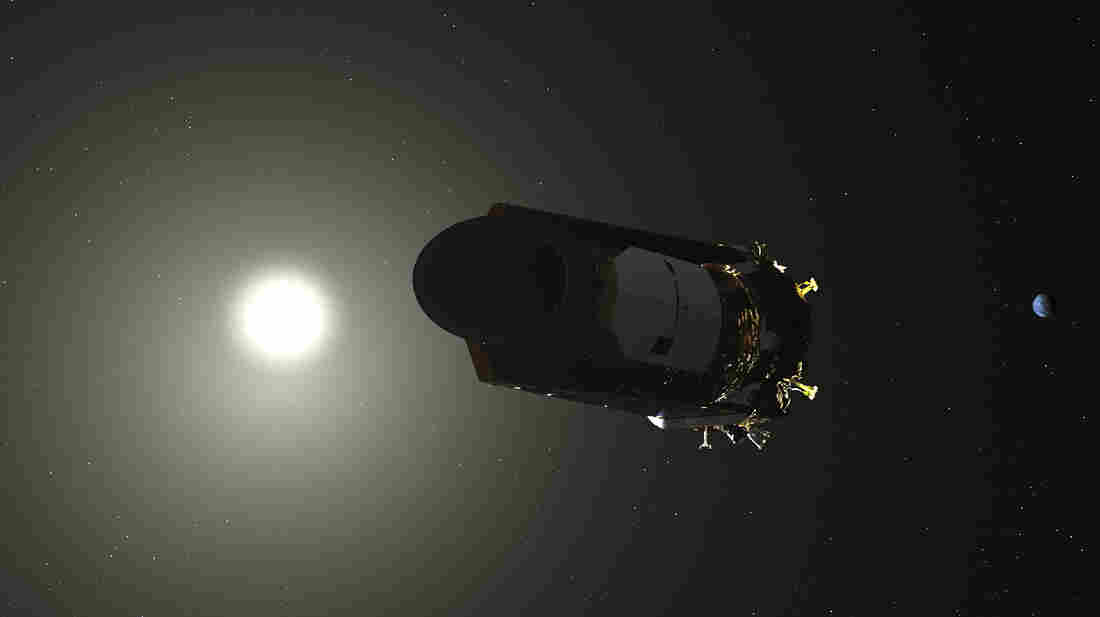
This illustration made available by NASA shows the Kepler space telescope, the planet-hunting spacecraft that launched in 2009. AP hide caption

toggle caption
AP

Toward the end of Kepler's life, mechanical failures meant it couldn't measure the light quite as accurately, so the data it collected were harder to interpret.

Dattilo modified an artificial intelligence program called AstroNet-K2 to work on data from the latter part of the Kepler mission. Once the modified program found stars that appeared to have planets, Dattilo and her colleagues used ground-based telescopes to confirm the findings.

The newly discovered planets, officially named K2-293b and K2-294b, orbit stars in the constellation Aquarius and are both slightly larger than Earth.

"If we want to know how many planets there are in total, we have to know how many planets we've found," Vanderburg said in a statement from the University of Texas McDonald Observatory. "But we also have to know how many planets we missed. That's where this [AI] comes in."

Vanderburg and Google engineer Chris Shallue "first used AI to uncover a planet around a Kepler star" in 2017, according to the statement.

Jessie Christiansen, a research scientist with NASA's Exoplanet Science Institute at the California Institute of Technology, says she's impressed by what Dattilo's team accomplished. And in a way, she's not all that surprised.

"NASA makes all of the data publicly available," Christiansen says. "You just have to think of a new idea of what to do with the data that no one has done before."

Michelle Ntampaka of the Harvard-Smithsonian Center for Astrophysics expects to see lots more astronomers using artificial intelligence techniques to analyze their data in the future. That's because newer telescopes don't so much collect images of stars and galaxies as digital data about these celestial objects.

"We're just going to see unprecedented data volumes, and we're going to have to come up with new ways to deal with that," Ntampaka says.

So writing a machine learning program as an undergrad is good preparation for Dattilo as she heads off to get her graduate degree in astronomy.

The discoveries have been accepted for publication in The Astronomical Journal.

Let's block ads! (Why?)


https://www.npr.org/2019/04/01/707967899/young-astronomer-uses-artificial-intelligence-to-discover-2-exoplanets

2019-04-01 09:07:00Z
CAIiEOZfw6IKIv1HiXpIh4qfDn4qFggEKg4IACoGCAow9vBNMK3UCDDq0Rc

'Did You See That?' Falling Meteor Caught On Camera In Florida - HuffPost

The National Weather Service confirmed Saturday that people across Florida and Georgia who spotted a bright green burning ball in the sky did, in fact, see a meteor falling from space. 

The service’s Tallahassee office tweeted that the meteor was picked up on its GOES Lightning Mapper, which usually tracks lightning, shortly before midnight on Saturday.

Videos posted to Twitter show a bright green burning ball falling through the sky, stunning people who were recording. “Did you see that?” a shocked spectator is heard saying in a video posted by user Jeffrey Cardona.

Local resident Jania Kadar told the Tallahassee Democrat that the night sky suddenly lit up like a stadium. 

“It lasted it felt like seconds,” she told the outlet. “The second my brain wanted me to say, ‘What is that?’ it was over.”

The National Weather Service has not yet announced if the fireball landed or broke apart in the air.

Let's block ads! (Why?)


https://www.huffpost.com/entry/falling-meteor-florida_n_5ca118c8e4b0474c08d065b8

2019-03-31 23:50:00Z
52780256058441